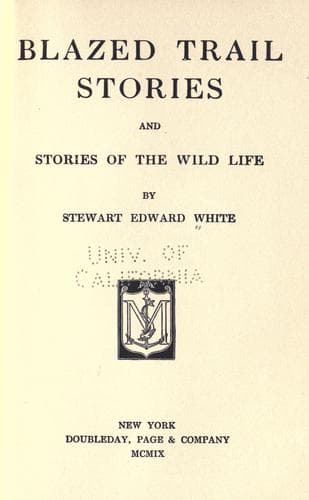
Blazed trail stories, and Stories of the wild lifeWhite, Stewart Edward
General
Blazed trail stories, and Stories of the wild life
White, Stewart Edward
Frontier and pioneer life -- West (U.S.) -- Fiction; Western stories
For reply, Tom fished out an old pack of cards.
"I tell you," he proposed, triumphantly, "I'll turn you fer it. First
man that gits a jack in th' hand-out stays."
He began to manipulate the cards, lying cramped on his side, and in
doing so dropped two or three. Alfred turned to pick them up. Tom deftly
slipped the jack of diamonds to the bottom of the pack. He inserted in
the centre those Alfred handed him, and began at once to deal.
"Thar's yore's," he said, laying out the four of clubs, "an' yere's
mine," he concluded, producing the jack of diamonds. "Luck's ag'in me
early in th' game," was his cheerful comment.
For a minute Alfred was silent, and a decided objection appeared in his
eyes. Then his instinct of fair play in the game took the ascendant. He
kicked off his chaps in the most business-like manner, unbuckled his
six-shooter and gave it to Tom, and perched his hat on the end of his
quirt, which he then raised slowly above the pony's side for the purpose
of drawing the enemy's fire. He did these things quickly and without
heroics, because he was a plainsman. Hardly had the bullets from three
Winchesters spatted against the clay before he was up and climbing for
dear life.
The Mexicans rushed to the opening from either side, fully expecting to
be able either to take wing-shots at close range, or to climb so fast as
to close in before the cowboys would have time to make a stand at the
top. In this they shut off their most effective fire--that of the three
men with the Winchesters--and, instead of getting wing-shots themselves,
they received an enthusiastic battering from Tom at the range of six
yards. Even a tenderfoot cannot over-shoot at six yards. What was left
of the Mexicans disappeared quicker than they had come, and the three of
the Winchesters scuttled back to cover like a spent covey of quail.
Tom then lit Alfred's pipe, and continued his excellent sculpture in the
bed of hard clay. He knew nothing more would happen until the posse
came. The game had passed out of his hands. It had become a race between
a short-legged man on foot and a band of hard riders on the backs of
very good horses. Viewing the matter dispassionately, Tom would not have
cared to bet on the chances.
As has been stated, Alfred was a small man and his legs were short--and
not only short, but unused to exertion of any kind, for Alfred's
daylight hours were spent on a horse. At the end of said legs were tight
boots with high French heels, which most Easterners would have
considered a silly affectation, but which all Westerners knew to be
purposeful in the extreme--they kept his feet from slipping forward
through the wide stirrups. In other respects, too, Alfred was
handicapped. His shoulders were narrow and sloping and his chest was
flat. Indoors and back East he would probably have been a consumptive;
out here, he was merely short-winded.
So it happened that Alfred lost the race.
Public-domain text, read in full here on John Shaqi.
Reviews
Reviews
No reviews yet
Be the first to share your thoughts on this work.
Elsewhere in the archive
Join the Discussion
Join the discussion
Sign in to leave a comment or review.
Sign InorCreate an account