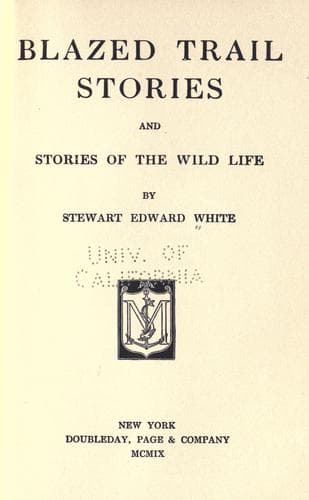
Blazed trail stories, and Stories of the wild lifeWhite, Stewart Edward
General
Blazed trail stories, and Stories of the wild life
White, Stewart Edward
Frontier and pioneer life -- West (U.S.) -- Fiction; Western stories
Now, one day, it happened that there appeared before this editor, Brown,
a young man bearing a roll of manuscript. How he had gotten by the
office boy Brown could not conceive, and rolled manuscript usually gave
him spasms. The youth, however, presented a letter of introduction from
Brown's best friend. He said he had a story to submit, and he said it
with a certain appearance of breathlessness at the end of the sentence,
which showed Brown that it was his first story. Brown frowned inwardly,
and smiled outwardly. He begged the youth to take a seat. As all the
seats were filled with unopened papers and unbound books, the youth said
he preferred to stand.
Brown asked the youth questions, in a perfunctory manner, not because he
cared to know anything about him, but because he liked the man who had
written the letter. The youth's name proved to be Severne, and he was
the most serious-minded youth who had ever stepped from college into
writing. He spoke of ideals. Brown concluded that the youth's story
probably dealt with the time of the Chaldaean astronomers, and contained
a deep symbolical truth, couched in language of the school of Bulwer
Lytton or Marie Corelli. So, after the youth had gone, he seized the
roll of manuscript, for the purpose of glancing through it. If he had
imagined the story of any merit, he would not have been in such haste;
but as his best friend had introduced the writer, he thought he would
like to get a disagreeable task over at once.
He glanced the story through. Then he read it carefully. Then he slammed
it down hard on his desk--to the vast confusion of some hundreds of
loose memoranda, which didn't matter much, anyway--and uttered a big,
bad word. The sentences in the story were short and crisp. The
adjectives were served very hot indeed. There was not a single bit of
poetic connotation. It described life as it really was.
Brown, the editor, published the story, and paid a good price for it.
Severne, the author, wrote more stories, and sold them to Brown. The two
men got to be very good friends, and Severne heard exactly how Brown
liked short stories and why, and how his, Severne's, stories were just
that kind.
Public-domain text, read in full here on John Shaqi.
Reviews
Reviews
No reviews yet
Be the first to share your thoughts on this work.
Elsewhere in the archive
Join the Discussion
Join the discussion
Sign in to leave a comment or review.
Sign InorCreate an account