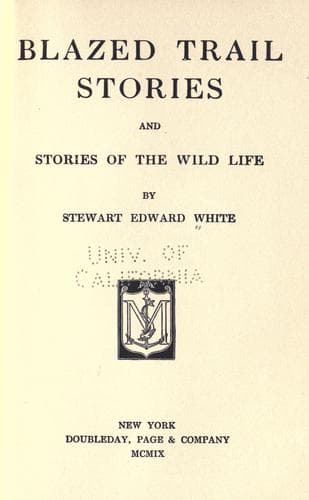
Blazed trail stories, and Stories of the wild lifeWhite, Stewart Edward
General
Blazed trail stories, and Stories of the wild life
White, Stewart Edward
Frontier and pioneer life -- West (U.S.) -- Fiction; Western stories
A sordid, silly enough little tale, is it not? but that is why men
wondered at Peter's survival, marvelled at the recuperative force that
made possible his fourth attempt, speculated with a certain awe over
that cheerful disposition which had earned him, even in his adversity,
the sobriquet of Happy Peter.
All of these phenomena, had they but known it, resulted from one simple
cause. Peter's mental retrospect for a considerable space would have
conjured up nothing but a succession of grand sweeps of mountains,
singing pines, rare western skies, and the simplicity of a
frontiersman's log-cabin; and yet to his inner vision over the border of
that space lay a very different scene. It was the scene he saw the
oftenest. Oftenest? he saw it always; across the mountains, through the
pines, beyond the skies. As time went on, the vision simplified itself
to Peter, as visions will. It came to have two phases, two elements,
which visited him always together.
One of these was a house; the other a girl. The house was low,
white-painted, with green blinds and a broad stoop. Its front yard was
fragrant with lilacs, noisy with crickets, fluttering with butterflies
of sulphur yellow. About it lay a stony, barren farm, but lovely with
the glamour of home. The girl was not pretty, as we know girls; but she
had straight steady eyes, a wide brow, smooth matronly bands of hair,
and a wholesome, homely New England character, sweet, yet with a tang to
give it a flavour, like the apples on the tree near the old-fashioned,
long-armed well. Peter could gain no competence from the stony farm, no
consent from the girl. It was to win both that he had come West.
In those days, around the western curve of the earth, every outlook
borrowed the tints of sunset. Nothing but the length of the journey
stood between a man and his fortune.
"I love you dearly, Peter," she had said, both hands on his shoulders,
"and I do not care for the money. But I have seen too much of it
here--too much of the unhappiness that comes from debt, from poverty.
Misery does not love the company of those it loves. Go make your
fortune, Peter, bravely, and come back to me."
"I will," replied Peter, soberly. "I will, God help me. But it may be
long. I don't know; I have not the knack; I am stupid about people,
about men."
She smiled, and leaned over to kiss his eyes. "People love you, Peter,"
she said, simply. "I love you, and I will wait. If it were fifty years,
you will find me here ready when you come."
Public-domain text, read in full here on John Shaqi.
Reviews
Reviews
No reviews yet
Be the first to share your thoughts on this work.
Elsewhere in the archive
Join the Discussion
Join the discussion
Sign in to leave a comment or review.
Sign InorCreate an account