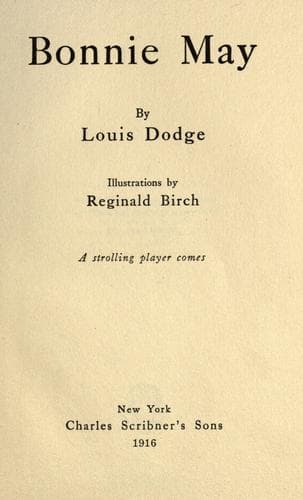
Actresses -- Fiction; Families -- Fiction; Foster children -- Fiction; Girls -- Fiction; Social classes -- Fiction
“Not a bit of it. We’re all very much pleased with you.”
There may have been something of patronage in the tone. At any rate,
she replied with a little smile: “Thank you. You know an artist
always strives to please.” As he regarded her quietly she added more
earnestly: “It’s strange that I got by, too, when you come to think
about it. I was hardly prepared to play a nice part when I came here.
Anyway, not a part where you have to have so much--what the critics
call restraint. You can take it from me, the nice parts aren’t half as
fat as the nasty parts.”
He did not remove his eyes from her face. He had the thought that she
was very far away from him, after all. From all of them. “I wish,” he
said, “you wouldn’t always talk as if you were only taking part in a
play. Somehow it doesn’t seem quite friendly. We’re trying to make this
a real home for you. We’re trying to be real friends. We’re trying to
live a real life. Why not look at it that way when you’re with me?
Wouldn’t that seem friendlier?”
She looked at him with a little flicker of anxiety in her eyes. “You
see,” she said, “I can’t help thinking all the time that everything I
do must be like a nice ingénue part, and being afraid that you’ll come
home some day and find I’ve been doing some soubrette stuff.”
He shook his head and abruptly assumed a new attitude. “Did you
understand me clearly when I said that Mrs. Thornburg wishes you to
visit her?”
“I think I didn’t pay much attention,” she admitted, looking away from
him. “Did you--wish me to go?”
“I think it would be very nice. If you didn’t like them, you needn’t
ever go again.” He tried to speak lightly.
She brought her eyes to his now, anxiously. “When did you think I ought
to go?” she asked.
Baron brought his chair down with a bump. “I didn’t say you ought to
go, exactly. Don’t put it that way. I only thought it would be nice and
kind of you to go, because they wish it. I’d be anxious to have you
come back quite soon, of course.”
“And--and mother: does she wish me to go, too?”
Her use of that word brought warmth to his heart. “She doesn’t wish
it. Frankly, I think she wouldn’t like it at all. But I think she’d
consent.”
She was greatly relieved. She leaned forward and patted him on the
knee. “I was afraid you might be planning to cut down the company,” she
said.
He looked at her without comprehending readily.
“I mean,” she elaborated, “I thought maybe it was a case of cold feet.”
He flinched. “Oh, Bonnie May!” was his disapproving rejoinder.
“You mean it’s stale?” she asked. The expression in her eyes was
innocent, perplexed.
He slowly shook his head in despair, and then he saw the swift look of
comprehension that brightened her eyes.
“Oh, I know,” she said. “Knock-about talk!”
He sprang to his feet and thrust his chair aside. “For a few moments
I would be very glad if we might use the English language,” he said.
“I was hopeful of arriving at an understanding with you on a certain
simple proposition.”
Public-domain text, read in full here on John Shaqi.
Reviews
Reviews
No reviews yet
Be the first to share your thoughts on this work.
Elsewhere in the archive
Join the Discussion
Join the discussion
Sign in to leave a comment or review.
Sign InorCreate an account