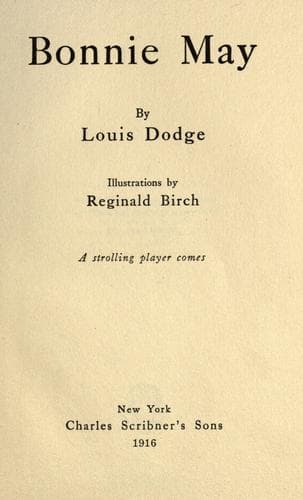
Actresses -- Fiction; Families -- Fiction; Foster children -- Fiction; Girls -- Fiction; Social classes -- Fiction
Baggot laughed lamely and his whole bearing expressed contempt. “You
don’t seem to be at all excited about it!” he complained.
Baron made no response to that. He was wondering where Baggot got his
enthusiasm for things.
“Well, the point is,” continued the other, “I’ve got a producer, and
it’s to be put on right away. Over at the Palace. They’ve got a summer
stock company, you know. They’re going to give it a trial performance.”
Baron was surprised. “I congratulate you,” he said. “I supposed such
things were pretty hard to manage.”
Baggot explained with complete frankness. “I know that. You see, I’ve
got an uncle who is financially interested in the Palace. He’s got
confidence in me--in this play, anyway. He made them give me a trial.
And that’s all I ask for. It’ll go like wild-fire. You’ll see.”
He had lighted another cigarette and was puffing nervously. “Where is
it?” he demanded. And when the manuscript was placed in his hands he
drew nearer to the light. With smoke curling up into his eyes he began
to read aloud. He held his head askew, to escape the smoke.
Baron leaned back, his face in shadow, and curiously studied the
intense manner of his companion.
Baggot read: fitfully, speedily, with an occasional aside, which he
dropped entirely when he got well into the action of the drama.
There was something of impersonation in his manner as he read now one
character’s lines and now another’s. He put so much interest into the
reading that it seemed almost like acting. And presently Baron began to
see vivid pictures. He was carried into a strange, pleasant atmosphere.
He was delighted by quaint, unexpected bits of dialogue. He perceived,
little by little, the trend of the whimsical philosophy.
He could scarcely believe that this was Baggot’s work. He forgot to
take account of time. And when the last act was finished, he found that
he had risen to his feet.
“Splendid!” he exclaimed. “Splendid!”
Baggot thrust the manuscript from him and turned to the other with
brilliant, triumphant eyes.
“No fault to find with that,” he challenged. In another moment he had
left the room, and was hurrying down the stairs and away from the
house, too excited to contain himself.
The manuscript remained where it had fallen.
Late the next afternoon Baron returned from a day’s work in the _Times_
office.
He was thinking of Baggot’s play. He meant to read it for himself--to
see how much he had been influenced the day before by Baggot’s almost
hypnotic enthusiasm.
He went up into the attic room--and there, much to his amazement and
delight, he was confronted by Bonnie May.
She blushed with confusion and looked at him almost guiltily.
“Back so soon!” he exclaimed.
“Why, it seemed to me I was away quite a long time.”
“Well, yes--I suppose I’ve been rather busy.” He looked about for
the manuscript, which seemed to have been removed. “Did you find it
pleasant at the Thornburgs’?” he asked. He was succeeding now in
getting back his habitual, quiet manner.
Public-domain text, read in full here on John Shaqi.
Reviews
Reviews
No reviews yet
Be the first to share your thoughts on this work.
Elsewhere in the archive
Join the Discussion
Join the discussion
Sign in to leave a comment or review.
Sign InorCreate an account