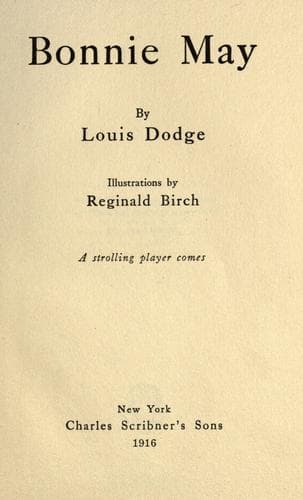
Actresses -- Fiction; Families -- Fiction; Foster children -- Fiction; Girls -- Fiction; Social classes -- Fiction
“That’s plain,” said Baron. He was trying not to be too much influenced
by the manager’s sudden humility, his voicing of a need. So far as he
knew, he had his own rights in the case. And above everything else
there was to be considered Bonnie May’s right. If it seemed best for
her to remain in the mansion, there, Baron resolved, she should remain,
until he was forced to release her. “That’s plain,” he repeated. “I
think it makes the case simple enough. At least it makes it simpler.
Why not communicate with these people who are advertising? If they have
any claim on her you can come to terms with them. They ought to be
glad to see her placed in a good home. If they haven’t any claims, the
sooner we know it the better.”
“I don’t intend to pay any attention to them,” declared Thornburg. He
was sullen and stubborn again.
“Well, of course it isn’t up to you,” agreed Baron mildly. “It’s I who
must do it, as of course I shall.”
“That’s precisely what I don’t want you to do. That’s why I sent for
you.”
Baron flushed. “But--” he objected.
“Do you know what’ll happen if you show your hand? I’ll tell you. A lot
of mountebanks will be pouring into your house. They’ll make it look
like a third-rate booking agency. Your people will like that!”
Baron could see the picture: the grotesque persons at his door; the
sallow tragedian with a bass voice and no mentality to speak of; the
low comedian, fat and obtuse; the ingénue with big, childish eyes and
deep lines in her face; the leading lady with a self-imposed burden of
cheap jewelry. He saw, too, the big-hearted among them, gravely kind
toward children, and with a carefully schooled yearning for them.
He straightened up with a jerk. “Oh, that wouldn’t be necessary,”
he declared. “I could correspond with them through the agency of
the newspaper. I needn’t give them my name and address at all. I
could require proper proofs before I appeared in the matter at all
personally.”
This idea seemed to strike Thornburg as a method of escape from
a dilemma. “Why shouldn’t I have thought of that way myself?” he
exclaimed. “I can do it that way, of course. Better for me than for
you. More in my line, at least.”
“I’m inclined to think I ought to do it myself,” objected Baron.
“I really don’t see why I should leave it to you.” Something in
Thornburg’s manner had created a suspicion in his mind. There was
something too eager in the manager’s tone; there was a hint of cunning.
“If I give you my word?” said Thornburg. He was resentful, offended.
His face had flamed to the roots of his hair.
“Oh, if you give me your word,” agreed Baron lightly. “I’ve no
objection. Certainly, go ahead.” He scrutinized his stick with a long,
frowning inspection. Then he arose with decision. “I’ll leave it to
you,” he added. “Only, I want to make one condition.”
“Oh--a condition! Well, what?”
Public-domain text, read in full here on John Shaqi.
Reviews
Reviews
No reviews yet
Be the first to share your thoughts on this work.
Elsewhere in the archive
Join the Discussion
Join the discussion
Sign in to leave a comment or review.
Sign InorCreate an account