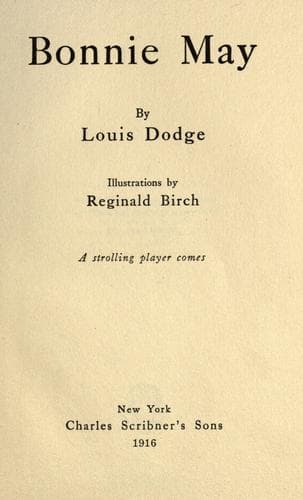
Actresses -- Fiction; Families -- Fiction; Foster children -- Fiction; Girls -- Fiction; Social classes -- Fiction
“I didn’t show him this. He doesn’t know. Surely you can understand.
He has acted a lie, in trying to get the little girl into the house
without telling me about her. And I can’t blame him for that, after
what happened that other time. But I can’t bear to let him know
that--that I know.”
“But don’t you see, if Bonnie May is really his daughter, and if he
weren’t afraid to tell you so, he could bring her here without any
further hinderance!”
“No, he couldn’t. Not if the mother wants her.”
Baron arose. “After all, it’s largely guesswork--conclusions reached
in the dark,” he said. “You’ve received an anonymous note. That’s all
the foundation you have for what you’ve told me. And people who write
anonymous letters....”
He reflected dubiously, and then he came to a decision.
“I’ve reason to believe,” he said, “that there is good ground for you
to reject what’s in that note.”
She leaned forward, observing him intently.
Baron was remembering the actress who had called on Thornburg; the
woman who, almost certainly, was she who had taken the child into
Thornburg’s theatre. He was recalling his question to the manager, and
the latter’s vehement, prompt response.
“You mean,” questioned Mrs. Thornburg, “that you don’t think Bonnie May
is really ... that you don’t believe it was her mother who wrote this
note?”
“It’s difficult to be quite sure of anything,” said Baron, “but I would
stake a great deal on that one thing being true--that it wasn’t Bonnie
May’s mother who wrote that anonymous note.”
CHAPTER XVII
“A KIND OF DUEL”
That night in his attic room Baron arrived, by perfectly logical
reasoning, at two conclusions, each of which was precisely the opposite
of the other.
The first of these conclusions was that he had a perfect right to shape
Bonnie May’s future according to his own inclination. The second was
that he had no right at all to do such a thing.
He arrived at the first conclusion in this manner:
He had made an honest effort to locate any person or persons having a
legal and just claim on the child, and he had failed. If the Thornburgs
had any claim upon her, it was not his fault that they had bungled
their affairs until they were unwilling to make their claim public.
Therefore he had a right to have and to hold Bonnie May, and to regard
her, if not as his own, at least as a permanent member of the household.
His second and contrary opinion began to shape itself when he recalled
the picture of Mrs. Thornburg, helpless and despairing, greatly
desiring the presence of the child in her own home in order that she
might complete a great moral victory over herself.
A man couldn’t oppose his claims and advantages to a need like that!
Besides--it was borne in upon Baron more and more strongly--there was a
very serious question as to the child’s best interests.
Public-domain text, read in full here on John Shaqi.
Reviews
Reviews
No reviews yet
Be the first to share your thoughts on this work.
Elsewhere in the archive
Join the Discussion
Join the discussion
Sign in to leave a comment or review.
Sign InorCreate an account