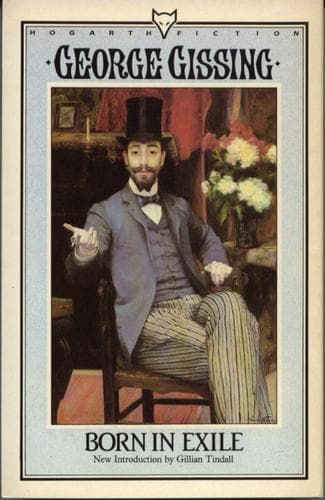
England -- Social life and customs -- 19th century -- Fiction; English fiction -- 19th century
'Well said! Keep your mind open. I marvel at the dogmatism of men who
are set on overthrowing dogma. Such a position is so strangely
unphilosophic that I don't know how a fellow of your brains can hold it
for a moment. If I were not afraid of angering you,' Martin added, in
his pleasantest tone, 'I would quote the Master of Trinity.'
'A capital epigram, but it is repeated too often.'
Mr. Warricombe shook his head, and with a laugh rose to say good-night.
'It's a great pity,' he remarked next day to Sidwell, who had been
saying that her brother seemed less vivacious than usual, 'that
Buckland is defective on the side of humour. For a man who claims to be
philosophical he takes things with a rather obtuse seriousness. I know
nothing better than humour as a protection against the kind of mistake
he is always committing.'
The application of this was not clear to Sidwell.
'Has something happened to depress him?' she asked.
'Not that I know of. I spoke only of his general tendency to
intemperate zeal. That is enough to account for intervals of reaction.
And how much sounder his judgment of men would be if he could only see
through a medium of humour now and then! You know he is going over to
Budleigh Salterton this afternoon?'
Sidwell smiled, and said quietly:
'I thought it likely he would.'
At Budleigh Salterton, a nook on the coast some fifteen miles away,
Sylvia Moorhouse was now dwelling. Her mother, a widow of substantial
means, had recently established herself there, in the proximity of
friends, and the mathematical brother made his home with them. That
Buckland took every opportunity of enjoying Sylvia's conversation was
no secret; whether the predilection was mutual, none of his relatives
could say, for in a matter such as this Buckland was by nature disposed
to reticence. Sidwell's intimacy with Miss Moorhouse put her in no
better position than the others for forming an opinion; she could only
suspect that the irony which flavoured Sylvia's talk with and
concerning the Radical, intimated a lurking kindness. Buckland's
preference was easily understood, and its growth for five or six years
seemed to promise stability.
Immediately after luncheon the young man set forth, and did not
reappear until the evening of the next day. His spirits had not
benefited by the excursion; at dinner he was noticeably silent, and
instead of going to the drawing-room afterwards he betook himself to
the studio up on the roof, and smoked in solitude. There, towards ten
o'clock, Sidwell sought him. Heavy rain was beating upon the glass, and
a high wind blended its bluster with the cheerless sound.
'Don't you find it rather cold here?' she asked, after observing her
brother's countenance of gloom.
'Yes; I'm coming down.--Why don't you keep up your painting?'
'I have lost interest in it, I'm afraid.'
'That's very weak, you know. It seems to me that nothing interests you
permanently.'
Sidwell thought it better to make no reply.
Public-domain text, read in full here on John Shaqi.
Reviews
Reviews
No reviews yet
Be the first to share your thoughts on this work.
Elsewhere in the archive
Join the Discussion
Join the discussion
Sign in to leave a comment or review.
Sign InorCreate an account