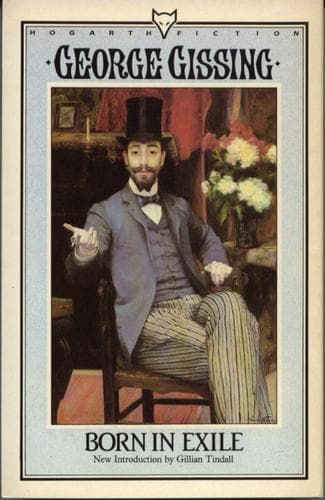
England -- Social life and customs -- 19th century -- Fiction; English fiction -- 19th century
In moods of discouragement he thought with envy of his old self, his
life in London lodgings, his freedom in obscurity. It belongs to the
pathos of human nature that only in looking back can one appreciate the
true value of those long tracts of monotonous ease which, when we are
living through them, seem of no account save in relation to past or
future; only at a distance do we perceive that the exemption from
painful shock was in itself a happiness, to be rated highly in
comparison with most of those disturbances known as moments of joy. A
wise man would have entertained no wish but that he might grow old in
that same succession of days and weeks and years. Without anxiety
concerning his material needs (certainly the most substantial of
earthly blessings), his leisure not inadequate to the gratification of
a moderate studiousness, with friends who offered him an ever-ready
welcome,--was it not much? If he were condemned to bachelorhood, his
philosophy was surely capable of teaching him that the sorrows and
anxieties he thus escaped made more than an offset against the
satisfactions he must forego. Reason had no part in the fantastic
change to which his life had submitted, nor was he ever supported by a
hope which would bear his cooler investigation.
And yet hope had her periods of control, for there are times when the
mind wearies of rationality, and, as it were in self-defense, in
obedience to the instinct of progressive life, craves a specious
comfort. It seemed undeniable that Mr. Warricombe regarded him with
growth of interest, invited his conversation more unreservedly. He
began to understand Martin's position with regard to religion and
science, and thus could utter himself more securely. At length he
ventured to discourse with some amplitude on his own convictions--the
views, that is to say, which he thought fit to adopt in his character
of a liberal Christian. It was on an afternoon of early August that
this opportunity presented itself. They sat together in the study, and
Martin was in a graver mood than usual, not much disposed to talk, but
a willing listener. There had been mention of a sermon at the
Cathedral, in which the preacher declared his faith that the maturity
of science would dispel all antagonisms between it and revelation.
'The difficulties of the unbeliever,' said Peak, endeavouring to avoid
a sermonising formality, though with indifferent success, 'are, of
course, of two kinds; there's the theory of evolution, and there's
modern biblical criticism. The more I study these objections, the less
able I am to see how they come in conflict with belief in Christianity
as a revealed religion.'
'Yet you probably had your time of doubt?' remarked the other, touching
for the first time on this personal matter.
Public-domain text, read in full here on John Shaqi.
Reviews
Reviews
No reviews yet
Be the first to share your thoughts on this work.
Elsewhere in the archive
Join the Discussion
Join the discussion
Sign in to leave a comment or review.
Sign InorCreate an account