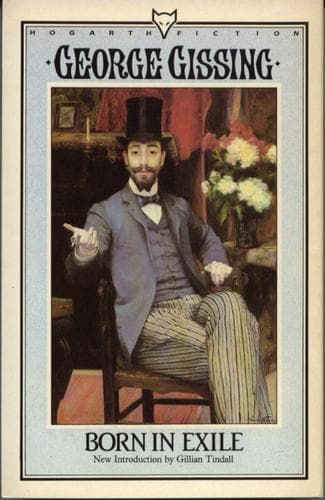
England -- Social life and customs -- 19th century -- Fiction; English fiction -- 19th century
This essay was not so repugnant to her mind or her feelings as when she
first became acquainted with it. Its bitterness no longer seemed to be
directed against herself. There was much in it with which she could
have agreed at any time during the last six months, and many strokes of
satire, which till the other day would have offended her, she now felt
to be legitimate. As she read on, a kind of anger such as she had never
experienced trembled along her nerves. Was it not flagrantly true that
English society at large made profession of a faith which in no sense
whatever it could be said sincerely to hold? Was there not every reason
to believe that thousands of people keep up an ignoble formalism,
because they feared the social results of declaring their severance
from the religion of the churches? This was a monstrous evil; she had
never till this moment understood the scope of its baneful effects. But
for the prevalence of such a spirit of hypocrisy, Godwin Peak would
never have sinned against his honour. Why was it not declared in
trumpet-tones of authority, from end to end of the Christian world,
that Christianity, as it has been understood through the ages, can no
longer be accepted? For that was the truth, the truth, the _truth_!
She lay back, quivering as if with terror. For an instant her soul had
been filled with hatred of the religion for which she could once have
died. It had stood before her as a power of darkness and ignorance, to
be assailed, crushed, driven from the memory of man.
Last night she had hardly slept, and now, though her body was numb with
weariness, her mind kept up a feverish activity. She was bent on
excusing Godwin, and the only way in which she could do so was by
arraigning the world for its huge dishonesty. In a condition between
slumber and waking, she seemed to plead for him before a circle of
Pharisaic accusers. Streams of silent eloquence rushed through her
brain, and the spirit which prompted her was closely akin to that of
'The New Sophistry'. Now and then, for a few seconds, she was smitten
with a consciousness of extraordinary change in her habits of thought.
She looked about her with wide, fearful eyes, and endeavoured to see
things in the familiar aspect. As if with physical constraint her angry
imagination again overcame her, until at length from the penumbra of
sleep she passed into its profoundest gloom.
To wake when dawn was pale at the window. A choking odour reminded her
that she had not extinguished the lamp, which must have gone out for
lack of oil. She opened the window, took a draught of water, and
addressed herself to sleep again. But in recollecting what the new day
meant for her, she had spoilt the chances of longer rest. Her head
ached; all worldly thoughts were repulsive, yet she could not dismiss
them. She tried to repeat the prayers she had known since childhood,
but they were meaningless, and a sense of shame attached to their
utterance.
Public-domain text, read in full here on John Shaqi.
Reviews
Reviews
No reviews yet
Be the first to share your thoughts on this work.
Elsewhere in the archive
Join the Discussion
Join the discussion
Sign in to leave a comment or review.
Sign InorCreate an account