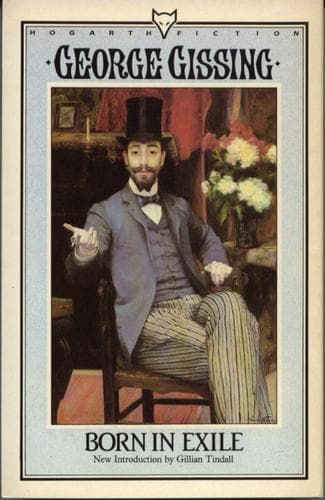
England -- Social life and customs -- 19th century -- Fiction; English fiction -- 19th century
'Not everything; something, perhaps. Remember your evolutionism. The
preservation of the race demands in women many kinds of irrationality,
of obstinate instinct, which enrage a reasoning man. Don't suppose I
speak theoretically. Four or five years ago I had really made up my
mind to marry; I wasted much valuable time among women and girls, of
anything but low social standing. But my passions were choked by my
logical faculty. I foresaw a terrible possibility--that I might beat my
wife. One thing I learned with certainty was that the woman, _qua_
woman, hates abstract thought--hates it. Moreover (and of consequence)
she despises every ambition that has not a material end.'
He enlarged upon the subject, followed it into all its ramifications,
elaborated the inconsistencies with which it is rife. Peak's reply was
deliberate.
'Admitting that some of these faults are rooted in sex, I should only
find them intolerable when their expression took a vulgar form. Between
irrationality and coarseness of mind there is an enormous distinction.'
'With coarse minds I have nothing to do.'
'Forgive me if I ask you a blunt question,' said Peak, after
hesitating. 'Have you ever associated with women of the highest
refinement?'
Earwaker laughed.
'I don't know what that phrase means. It sounds rather odd on your
lips.'
'Well, women of the highest class of commoners. With peeresses we
needn't concern ourselves.'
'You imagine that social precedence makes all that difference in women?'
'Yes, I do. The daughter of a county family is a finer being than any
girl who can spring from the nomad orders.'
'Even supposing your nomads produce a Rachel or a Charlotte Brontë?'
'We are not talking of genius,' Peak replied.
'It was irrelevant, I know.--Well, yes, I _have_ conversed now and then
with what you would call well-born women. They are delightful
creatures, some of them, in given circumstances. But do you think I
ever dreamt of taking a wife drenched with social prejudices?'
Peak's face expressed annoyance, and he said nothing.
'A man's wife,' pursued Earwaker, 'may be his superior in whatever you
like, _except_ social position. That is precisely the distinction that
no woman can forget or forgive. On that account they are the
obstructive element in social history. If I loved a woman of rank above
my own she would make me a renegade; for her sake I should deny my
faith. I should write for the _St. James's Gazette_, and at last poison
myself in an agony of shame.'
A burst of laughter cleared the air for a moment, but for a moment
only. Peak's countenance clouded over again, and at length he said in a
lower tone:
'There are men whose character would defy that rule.'
'Yes--to their own disaster. But I ought to have made one exception.
There is a case in which a woman will marry without much regard to her
husband's origin. Let him be a parson, and he may aim as high as he
chooses.'
Peak tried to smile. He made no answer, and fell into a fit of brooding.
Public-domain text, read in full here on John Shaqi.
Reviews
Reviews
No reviews yet
Be the first to share your thoughts on this work.
Elsewhere in the archive
Join the Discussion
Join the discussion
Sign in to leave a comment or review.
Sign InorCreate an account