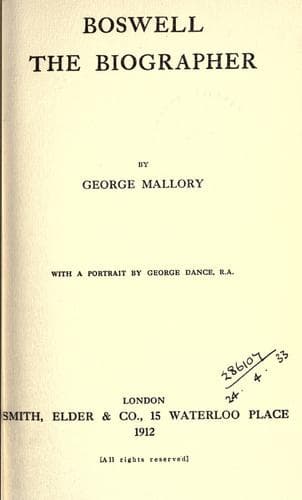
Authors, Scottish -- 18th century -- Biography; Biographers -- Great Britain -- Biography; Boswell, James, 1740-1795
'His social propensities,' says Sir J. Prior, 'were well known ...
he opens his mind so freely that we discover much of what is passing
there, even when the disclosure is not meant.'[38] Boswell, indeed,
talked very readily even upon the most serious subjects. About morals
and religion he was continually questioning Dr. Johnson, and most of
all about what to the other was a peculiarly sacred and awful thing,
the fear of death. The topics were introduced apparently without any
particular reason or fitness, but just as it occurred to Boswell that
he might elicit some response from Johnson upon questions about which
it was essential to his purpose that he should hear the doctor's
views: and they were introduced too not merely in private converse but
when a number of people were present.
It seems clear that Boswell was sometimes very tactless in leading
Johnson to talk; he did not understand that not every company nor
every occasion is suitable for the discussion of the most serious
matters. He had, too, an unfortunate habit of saying things which were
extremely injudicious. He did not even understand altogether what was
likely to annoy Dr. Johnson--as on the occasion when he referred to
him in company by the name 'Gargantua,' which Johnson had spoken of as
having been applied to himself, or when he made what must have been an
obvious reference to Johnson's curious clothes: 'Would not _you_, sir,
be the better for velvet embroidery?' These remarks were made, it is
evident, without any malevolent intention. It would seem that even
when he meant to be rude he did not realise all the harm he was doing:
Hume was with some justice annoyed when Boswell quoted the phrase of
Temple, 'their infidel pensioner, Hume';[39] and it was introduced
just as a child might say in some personal argument, 'I know what
someone said of _you_'; and Foote can never have felt much friendship
for Johnson after he heard that the latter had compared his infidelity
to that of a dog.[40] The company in both cases may have been glad
to see Boswell defend his friend, but they must have thought him a
considerable fool and hardly a harmless one.
Nor was it merely from his disregard of what was appropriate that his
conversation might be thought foolish, but rather because a man who
is very ready to talk of his most intimate thoughts and feelings is
usually supposed to be a fool.
Boswell certainly had far more candour than most men, and he had also
a far greater curiosity and interest in mankind, which made him ready
to talk like a child of things about which many men prefer to be
silent. But it would seem, too, that though far from incapable of
feeling deep emotion he was unaffected where most of us would be
touched. 'He was a boy longer than others,' and this perhaps is the
explanation.
[Footnote 1: _Letters to Temple_, pp. 146-7.]
[Footnote 2: _Letters to Temple_, p. 157.]
[Footnote 3: _Letters to Temple_, p. 250.]
Public-domain text, read in full here on John Shaqi.
Reviews
Reviews
No reviews yet
Be the first to share your thoughts on this work.
Elsewhere in the archive
Join the Discussion
Join the discussion
Sign in to leave a comment or review.
Sign InorCreate an account