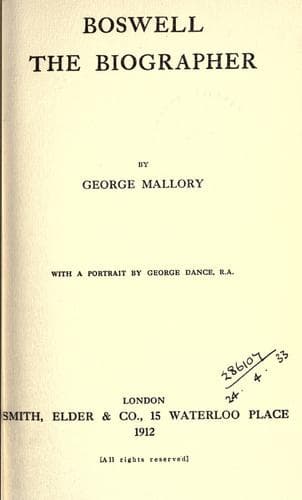
Authors, Scottish -- 18th century -- Biography; Biographers -- Great Britain -- Biography; Boswell, James, 1740-1795
Boswell's method of recording conversations was not completed in
these memoranda taken down at the moment. He had, besides these,
his journal. It has been remarked already that he began to keep this
regularly as early as 1758 during his tour on the Northern Circuit in
the company of his father and Lord Hailes, and he tells us something
of it at the time of his journey to Greenwich with Johnson in 1763:
I was the more sensible of it (the cold) from having sat up
all the night before _recollecting and writing_ in my journal
what I thought worthy of preservation; an exertion which,
during the first part of my acquaintance with Johnson, I
frequently made. I remember having sat up four nights in one
week, without being much incommoded in the daytime.
In the 'Tour to Corsica,' also, he tells us:
From my first setting out on this tour, I wrote down every
night what I had observed during the day, throwing together a
great deal, that I might afterwards select at leisure.[2]
We have then two processes mentioned by which Boswell recorded
conversation: the notes taken down at the moment, and the journal
written up at night. The relation of these two--the function which
each of them performed--is not difficult to conjecture.
Boswell's object was to get his records written up as soon as possible
after the events or conversations which he was describing:
I found, from experience, that to collect my friend's
conversation so as to exhibit it with any degree of its
original flavour, it was necessary to write it down without
delay. To record his sayings, after some distance of time,
was like preserving or pickling long-kept or faded fruits, or
other vegetables, which, when in that state, have little or
nothing of their taste when fresh.[3]
It was upon the fact that he trusted, not to his memory, but to
'exact transcript of conversations,' that Boswell based his claim to
authenticity.[4] He was so absolutely truthful himself, that it never
occurred to him to think that the truth of what was actually written
down at the time could be doubted, and it was to him an entire
refutation of any adversary to confront him with his method.
If this book should again be reprinted, I shall with the
utmost readiness correct any errours I may have committed, in
stating conversations, provided it can be clearly shown to me
that I have been inaccurate. But I am slow to believe (as
I have elsewhere observed) that any man's memory, at the
distance of several years, can preserve facts or sayings with
such fidelity as may be done by writing them down when they
are recent: and I beg it may be remembered, that it is not
upon _memory_, but upon what was _written at the time_, that
the authenticity of my 'Journal' rests.[5]
Public-domain text, read in full here on John Shaqi.
Reviews
Reviews
No reviews yet
Be the first to share your thoughts on this work.
Elsewhere in the archive
Join the Discussion
Join the discussion
Sign in to leave a comment or review.
Sign InorCreate an account