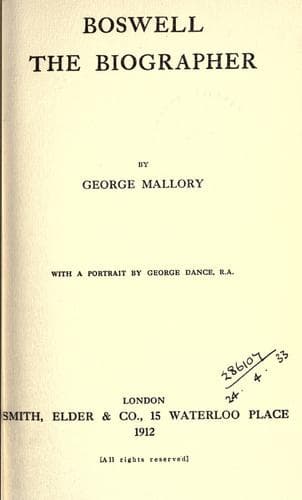
Authors, Scottish -- 18th century -- Biography; Biographers -- Great Britain -- Biography; Boswell, James, 1740-1795
Of the impulse to expression and what it meant in Boswell's case
something has been said already in these pages. We cannot understand
the engine if we forget the power that drives it, and we must
emphasise once again the force that Boswell obeyed. His passion for
truth was not comprehensive: and it was for the truth of the realist,
not the truth of the idealist. It did not include the whole of life;
it did not attempt to view the entire scene in correct perspective;
and Boswell was decidedly not a philosopher. He did not greatly need
explanations of the universe; he tended to accept such as seemed
convenient. He had no logic about abstract theories, and only a very
limited power of criticising evidence. One who cares for truth with
respect to every fact and deduction is inclined to reject his first
impressions, because experience has taught him that 'all men are
liars.' The face of things is so often false! But Boswell was content
to look no further; he sometimes deliberately disregarded the facts
of existence; he lived one half his life in a glitter of his own
creation. Nevertheless, the passion for truth was vivid and vital. It
lived apart to work out its own consummation; and it was all the more
vehement for being confined. It is perhaps for this reason--that the
truth inherent in Boswell was confined within such strict limits--that
it required expression. In these circumstances Boswell's buoyant
nature had need of a safety-valve. Truth for him was concerned
entirely with an external view of people. He was rarely analytical; he
did not care for subtle states of mind and the feelings that composed
them; he looked directly at actions and their primary motives. The
vision was so clear and strong that Boswell by its very insistence was
obliged to create an imperishable image.
The reasons that made it certain from the beginning that Johnson would
become the vehicle for this expression extend beyond those qualities
which made Boswell prefer and admire him above all other men; they
depend upon Boswell's attitude towards mankind. We have seen that
he apologises and justifies himself for relating the weaknesses and
absurdities of Johnson. And yet he sometimes seems to have a peculiar
delight in them. These shades in Johnson's character are dealt with
not as an unpleasant but necessary task, to be despatched with a light
touch as though it ill became him to speak of them, but with a full
flavour of rich and lasting enjoyment.
Public-domain text, read in full here on John Shaqi.
Reviews
Reviews
No reviews yet
Be the first to share your thoughts on this work.
Elsewhere in the archive
Join the Discussion
Join the discussion
Sign in to leave a comment or review.
Sign InorCreate an account