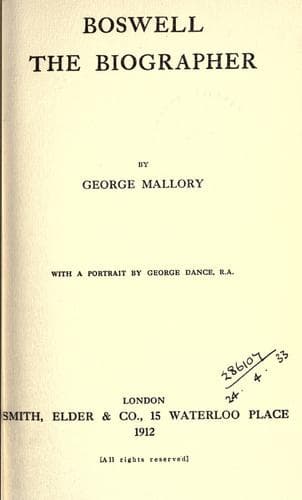
Authors, Scottish -- 18th century -- Biography; Biographers -- Great Britain -- Biography; Boswell, James, 1740-1795
In reflecting that the illustrious subject of this Work, by
being more extensively and more intimately known, however
elevated before, has risen in the veneration and love of
mankind, I feel a satisfaction beyond what fame can afford....
It seems to me, in my moments of self-complacency, that this
extensive biographical work, however inferior in its nature,
may in one respect be assimilated to the Odyssey.
Boswell goes on to explain that the 'Hero,' like Ulysses, 'in the
whole course of the History, is exhibited by the authour for the best
advantage of his readers.' So certain is he of the merits of his book
that he tells his readers, in so many words, that, if they do not like
it, their own bad temper is to blame.
Should there be any cold-blooded morose mortals who really
dislike this Book, I will give them a story to apply. When the
great Duke of Marlborough, accompanied by Lord Cadogan, was
one day reconnoitering the army in Flanders, a heavy rain
came on and they both called for their cloaks. Lord Cadogan's
servant, a good-humoured, alert lad, brought his Lordship's
in a minute. The Duke's servant, a lazy sulky dog, was so
sluggish, that his Grace being wet to the skin, reproved him,
and had for answer, with a grunt, 'I came as fast as I could,'
upon which the Duke calmly said, 'Cadogan, I would not for a
thousand pounds have that fellow's temper.'
Boswell's satisfaction with his literary labours was certainly
well-founded. It is fair to remind those who may condemn this attitude
that he allowed an unduly large share of the book's merits to Dr.
Johnson. Interesting and lovable as Johnson was, he had little to do
with Boswell's execution. The biographer was fortunate--peculiarly
fortunate--in his subject: so much must be allowed and no more.
Boswell's pride did not exceed his deserts. But his 'moments of
self-complacency' must have provided a considerable compensation
for despondent moods when he regretted failure in other spheres. His
'satisfaction' reached a very high pitch when he could calmly say
to an unappreciative reader--for that is what it amounts to--that he
would be sorry to have a temper like that.
It is not remarkable for an author to feel as self-satisfied as
Boswell. Many authors tell their readers, though not so frankly, that
they ought to be interested in a book, and few give so good reasons as
Boswell gave. The point has been laboured here in order to illustrate
the final stage in his paradoxical development; to show in what degree
Boswell, while realising failure in all his magnificent dreams, was
satisfied with the fame he had of another sort. Assuredly he was
pleased with what he had; the degree may be judged from this final
extract from the Advertisement to the Second Edition:
Public-domain text, read in full here on John Shaqi.
Reviews
Reviews
No reviews yet
Be the first to share your thoughts on this work.
Elsewhere in the archive
Join the Discussion
Join the discussion
Sign in to leave a comment or review.
Sign InorCreate an account