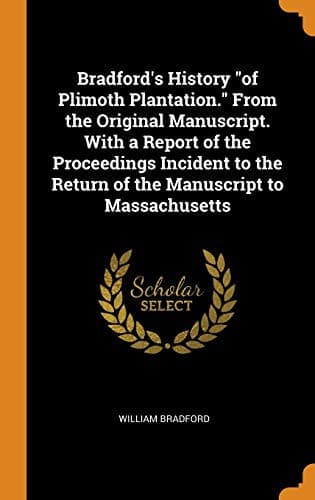
Bradford's History of 'Plimoth Plantation': From the Original Manuscript. With a Report of the Proceedings Incident to the Return of the Manuscript to MassachusettsBradford, William
History
Bradford's History of 'Plimoth Plantation': From the Original Manuscript. With a Report of the Proceedings Incident to the Return of the Manuscript to Massachusetts
Bradford, William
Massachusetts -- History -- Colonial period, ca. 1600-1775
Brethren, having latly sent 2. of our body unto you, to agitate &
bring to an issue some maters in difference betweene us, about some
lands at Conightecutt, unto which you lay challeng; upon which God by
his providence cast us, and as we conceive in a faire way of
providence tendered it to us, as a meete place to receive our body,
now upon removall.
We shall not need to answer all y^e passages of your larg letter, &c.
But wheras you say God in his providence cast you, &c., we tould you
before, and (upon this occasion) must now tell you still, that our
mind is other wise, and y^t you cast rather a partiall, if not a
covetous eye, upon that w^ch is your neigbours, and not yours; and in
so doing, your way could not be faire unto it. Looke y^t you abuse not
Gods providence in such allegations.
Theirs.
Now allbeite we at first judged y^e place so free y^t we might with
Gods good leave take & use it, without just offence to any man, it
being the Lords [213] wast, and for y^e presente altogeather voyd of
inhabitants, that indeede minded y^e imploymente therof, to y^e right
ends for which land was created, Gen: 1. 28. and for future intentions
of any, & uncertaine possibilities of this or that to be done by any,
we judging them (in such a case as ours espetialy) not meete to be
equalled with presente actions (such as ours was) much less worthy to
be prefered before them; and therfore did we make some weake beginings
in that good worke, in y^e place afforesaid.
Ans: Their answer was to this effecte. That if it was y^e Lords wast, it
was them selves that found it so, & not they; and have since bought it
of y^e right oweners, and maintained a chargable possession upon it al
this while, as them selves could not but know. And because of present
ingagments and other hinderances which lay at presente upon them, must
it therfore be lawfull for them to goe and take it from them? It was
well known that they are upon a barren place, wher they were by
necessitie cast; and neither they nor theirs could longe continue upon
y^e same; and why should they (because they were more ready, & more able
at presente) goe and deprive them of that which they had w^th charg &
hazard provided, & intended to remove to, as soone as they could & were
able?
They had another passage in their letter; they had rather have to doe
with the lords in England, to whom (as they heard it reported) some of
them should say that they had rather give up their right to them, (if
they must part with it,) then to y^e church of Dorchester, &c. And that
they should be less fearfull to offend y^e lords, then they were them.
Public-domain text, read in full here on John Shaqi.
Reviews
Reviews
No reviews yet
Be the first to share your thoughts on this work.
Elsewhere in the archive
Join the Discussion
Join the discussion
Sign in to leave a comment or review.
Sign InorCreate an account