The last figure represents Almeric, Lord St. Amand, whose headpiece
is extremely peculiar (Fig. 177). The globular bascinet appears to
be protected by a steel bonnet, or chapelle-de-fer, having a wide
projecting rim which worked upon pivots at either side and could be
brought down when required level with the eyes, while the back would
afford some protection for the neck. A comb or ridge is also shown,
probably hollow, and enclosing a similar small ridge on the bascinet,
upon which it would run as a guide. This is the only example of a
headpiece of this fashion engraved upon a brass, but on the monumental
effigy of Aymer de Valence at Westminster, _c._ 1296, one of the
equestrian figures is shown similarly habited. The gorget is different
from that of Hastings in being hollowed out at the sides; it rests
directly upon the camail, which is shown with very large and coarse
markings.
In all the figures the sword is suspended at a single point and not
at two as in the Cyclas and previous periods, while the cord round
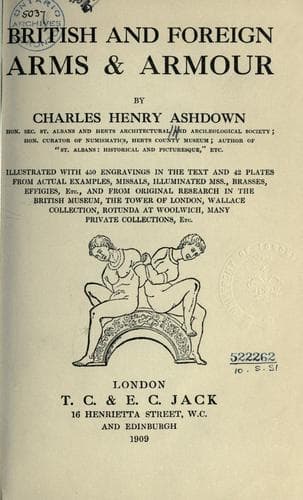
the waist is also dispensed with. The woodcut heading our Preface
indicates crudely the armour prevailing in this period. The subject of
the illustration is unknown, but it probably represents an episode at
a mediæval garden-party, where a section of the guests indulge in a
little “gentle and joyous sport” for the edification of the others.
In connection with the armour of the Studded and Splinted Periods
the representation of the sovereigns of England upon the coinage is
of considerable interest, inasmuch as it illustrates in a remarkable
degree the extraordinary conservatism of the moneyers and die-sinkers
of the mediæval period. The first representation of regal defensive
equipment occurs in the reign of King Edward III., and in the
Studded and Splinted Period. The gold noble of the second coinage
of this monarch represents him standing in a ship bearing a shield
upon his left arm and a sword in his right. The shield is large and
heater-shaped, and the sword has a short grip, a globular pommel, and
short quillons drooping towards the blade, which is long, and narrows
gradually towards the point. Camail of very capacious extent covers
the body nearly to the waist and extends down the arms to the elbow;
from below this the sleeve of a mail hauberk appears, covering a
small portion of the forearm and pendent about a foot. The forearm is
apparently unprotected, but a gauntlet covers the right hand, which
alone is visible. Upon the jupon appearing below the camail are four
studs, indicating pourpoint defence. In 1346, the half-noble exhibits
a much more contracted camail, a tightly fitting jupon with short
sleeves, and the sleeve of a chain mail hauberk apparently reaching
to the hand. The noble of 1351 shows camail, a short-sleeved jupon
revealing a hauberk reaching to the elbow, from beneath which issues a
loose sleeve to the wrist, of soft folding material, probably part of
the gambeson.
Public-domain text, read in full here on John Shaqi.
Reviews
Reviews
No reviews yet
Be the first to share your thoughts on this work.
Elsewhere in the archive
Join the Discussion
Join the discussion
Sign in to leave a comment or review.
Sign InorCreate an account