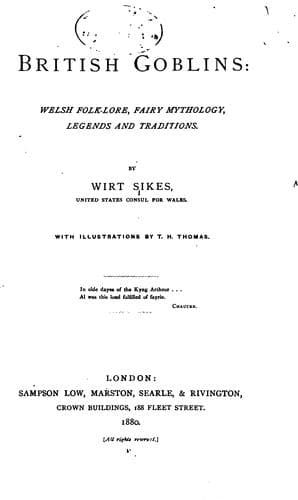
British Goblins: Welsh Folk-lore, Fairy Mythology, Legends and TraditionsSikes, Wirt
History
British Goblins: Welsh Folk-lore, Fairy Mythology, Legends and Traditions
Sikes, Wirt
Folklore -- Wales; Goblins -- Wales; Mythology, Celtic -- Wales; Mythology, Welsh; Wales -- Social life and customs
There are many points in all these traditional stories which are
suggestive of interesting comparisons, and constantly remind us of the
significance of details which, at first sight, seem trivial. The
supposed adoption of the hare form by the tailor recalls a host of
mythological details. The hare has been identified with the sun-god
Michabo of the American Indians, who sleeps through the winter months,
and symbolises the sleep of nature precisely as in the fairy myth of
the Sleeping Maiden, and the Welsh legends of Sleeping Heroes. Among
the Hottentots, the hare figures as the servant of the moon. In China,
the hare is viewed as a telluric genius in one province, and
everywhere as a divine animal. In Wales, one of the most charming of
the local legends relates how a hare flying from the hounds took
refuge under a fair saint's robes, so that hares were ever after
called Monacella's Lambs in that parish. Up to a comparatively recent
time, no person in the parish would kill a hare. When a hare was
pursued by dogs, it was firmly believed that if any one cried, 'God
and St. Monacella be with thee,' it was sure to escape. The legend is
related by Pennant, in his tour through Montgomeryshire: 'At about two
miles distant from Llangynog, I turned up a small valley to the right,
to pay my devotions to the shrine of St. Monacella, or, as the Welsh
style her, Melangell.... She was the daughter of an Irish monarch, who
had determined to marry her to a nobleman of his court. The princess
had vowed celibacy. She fled from her father's dominions, and took
refuge in this place, where she lived fifteen years without seeing
the face of man. Brochwel Yscythrog, prince of Powys, being one day a
hare-hunting, pursued his game till he came to a great thicket; when
he was amazed to find a virgin of surprising beauty engaged in deep
devotion, with the hare he had been pursuing under her robe, boldly
facing the dogs, who retired to a distance, howling, notwithstanding
all the efforts of the sportsmen to make them seize their prey. When
the huntsman blew his horn, it stuck to his lips. Brochwel heard her
story, and gave to God and her a parcel of lands to be a sanctuary to
all who fled there. He desired her to found an abbey on the spot. She
did so, and died abbess of it, in a good old age. She was buried in
the neighbouring church.... Her hard bed is shown in the cleft of a
neighbouring rock. Her tomb was in a little chapel, or oratory,
adjoining to the church and now used as a vestry-room. This room is
still called cell y bedd, (cell of the grave).... The legend is
perpetuated by some rude wooden carvings of the saint, with numbers of
hares scuttling to her for protection.'
X.
Public-domain text, read in full here on John Shaqi.
Reviews
Reviews
No reviews yet
Be the first to share your thoughts on this work.
Elsewhere in the archive
Join the Discussion
Join the discussion
Sign in to leave a comment or review.
Sign InorCreate an account