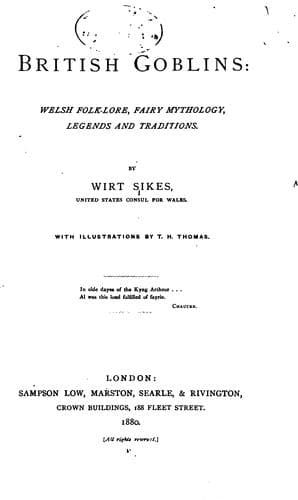
British Goblins: Welsh Folk-lore, Fairy Mythology, Legends and TraditionsSikes, Wirt
History
British Goblins: Welsh Folk-lore, Fairy Mythology, Legends and Traditions
Sikes, Wirt
Folklore -- Wales; Goblins -- Wales; Mythology, Celtic -- Wales; Mythology, Welsh; Wales -- Social life and customs
Much stress is usually laid, in accounts of the Gwyllgi, on the terror
with which it inspires domestic animals. This confidence in the
ability of the brute creation to detect the presence of a spirit, is a
common superstition everywhere. An American journal lately gave an
account of an apparition seen in Indiana, whose ghostly character was
considered by the witnesses to be proven by the terror of horses which
saw it. They were drawing the carriage in which drove the persons to
whom the ghost appeared, and they shied from the road at sight of it,
becoming unmanageable. The spectre soon dissolved in thin air and
vanished, when the horses instantly became tractable. In Wales it is
thought that horses have peculiarly this 'gift' of seeing spectres.
Carriage horses have been known to display every sign of the utmost
terror, when the occupants of the carriage could see no cause for
fright; and in such cases a funeral is expected to pass there before
long, bearing to his grave some person not dead at the time of the
horses' fright. These phenomena are certainly extremely interesting,
and well calculated to 'bid us pause,' though not, perhaps, for the
purpose of considering whether a horse's eye can receive an image
which the human retina fails to accept. Much weight will not be given
to the fright of the lower animals, I fear, by any thoughtful person
who has witnessed the terror of a horse at sight of a flapping shirt
on a clothes-line, or that hideous monster a railway engine. Andrew
Jackson Davis has a theory that we all bear about us an atmosphere,
pleasing or repulsive, which can be detected by horses, dogs, and
spiritual 'mediums;' this _aura_, being spiritual, surrounds us
without our will or wish, goes where we go, but does not die when we
die, and is the means by which a bloodhound tracks a slave, or a fond
dog finds its master. Without denying the possibility of this theory,
I must record that in my observation a dog has been found to smell his
master most successfully when that master was most in need of a bath
and a change of linen. Also, that when the master leaves off his coat
he clearly leaves--if a dog's conduct be evidence--a part of his
_aura_ with it. More worthy of serious attention is August Comte's
suggestion that dogs and some other animals are perhaps capable of
forming fetichistic notions. That dogs accredit inanimate objects with
volition, to a certain extent, I am quite convinced. The thing which
constitutes knowledge, in dogs as in human beings--that is to say,
thought, organised by experience--corrects this tendency in animals as
they grow older, precisely as it corrects the false conclusions of
children, though never to the same extent. That a dog can think, I
suppose no well-informed person doubts in these days.
V.
Public-domain text, read in full here on John Shaqi.
Reviews
Reviews
No reviews yet
Be the first to share your thoughts on this work.
Elsewhere in the archive
Join the Discussion
Join the discussion
Sign in to leave a comment or review.
Sign InorCreate an account