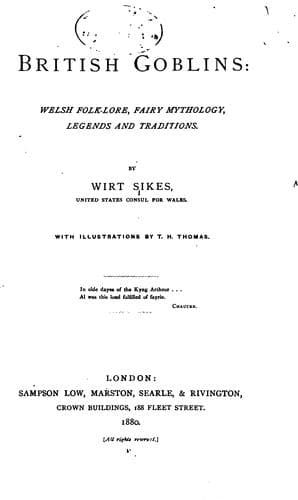
British Goblins: Welsh Folk-lore, Fairy Mythology, Legends and TraditionsSikes, Wirt
History
British Goblins: Welsh Folk-lore, Fairy Mythology, Legends and Traditions
Sikes, Wirt
Folklore -- Wales; Goblins -- Wales; Mythology, Celtic -- Wales; Mythology, Welsh; Wales -- Social life and customs
Particularly did this frisky Tridoll spirit trouble the maid-servant
after she had gone to bed--in winter hauling the bed-clothes off her;
in summer piling more on her. Now there was a young man, a first
cousin to William Thomas, who could not be got to believe there was a
spirit at his kinsman's house, and said the family were only making
tricks with one another, 'and very strong he was, a hero of an
unbeliever, like many of his brethren in infidelity.' One night
William Thomas and his wife went to a neighbour's wake, and left the
house in charge of the doubting cousin, who searched the place all
over, and then went to bed there; and no spirit came to disturb him.
This made him stronger than ever in his unbelief. But soon after he
slept there again, when they were all there, and before going to bed
he said aloud to the maid, 'If anything comes to disturb thee, Ally,
call upon me, as I lie in the next room to you.' During the night the
maid cried out that the spirit was pulling the clothes off her bed,
and the doubting cousin awoke, jumped out of bed, and ran to catch the
person he believed to be playing tricks with the maid. But there was
no creature visible, although there rained upon his doubting head a
series of cuffs, and about his person a fusillade of kicks, which
thrust the unbelief quite out of him, so that he doubted no more. The
departure of this spirit came about thus: William Thomas being in bed
with his wife, heard a voice calling him. He awaked his wife, and
rising on his elbow said to the invisible spirit, 'In the name of God
what seekest thou in my house? Hast thou anything to say to me?' The
spirit answered, 'I have,' and desired him to remove certain things
out of a place where they had been mislaid. 'Satan,' answered William
Thomas, in a candid manner, 'I'll do nothing thou biddest me; I
command thee, in the name of God, to depart from my house.' And it
obeyed.
VII.
This long and circumstantial account, which I have gathered from
different sources, but mainly from the two books of the Prophet Jones,
will impress the general reader with its resemblance, in many
respects, to modern newspaper ghost stories. The throwing about of
dishes, books, keys, etc.; its raps and touches of the person; its
making of loud noises by banging down metal objects; all these antics
are the tricks of contemporaneous spiritualism. But this spectre is of
a date when our spiritualism was quite unknown. The same is true of
the spirit which threw stones, another modern spiritualistic
accomplishment.[75] The spiritualists will argue from all this that
their belief is substantiated, not by any means that it is shaken. The
doubter will conclude that there were clever tricksters in humble
Welsh communities some time before the American city of Rochester had
produced its 'mediums.'
Public-domain text, read in full here on John Shaqi.
Reviews
Reviews
No reviews yet
Be the first to share your thoughts on this work.
Elsewhere in the archive
Join the Discussion
Join the discussion
Sign in to leave a comment or review.
Sign InorCreate an account