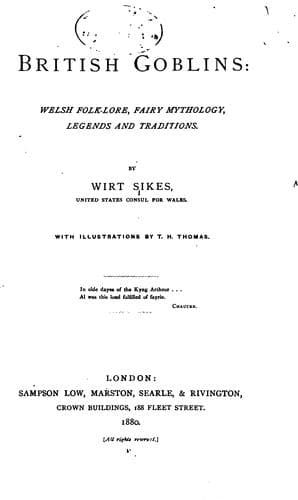
British Goblins: Welsh Folk-lore, Fairy Mythology, Legends and TraditionsSikes, Wirt
History
British Goblins: Welsh Folk-lore, Fairy Mythology, Legends and Traditions
Sikes, Wirt
Folklore -- Wales; Goblins -- Wales; Mythology, Celtic -- Wales; Mythology, Welsh; Wales -- Social life and customs
As this familiar spirit got better acquainted with its quarters, it
became more talkative, and used often to speak from out of an oven by
the hearth's side. It also took to making music o' nights with Job's
fiddle. One night as Job was going to bed, the familiar spirit gave
him a gentle stroke on the toe. 'Thou art curious in smiting,' said
Job. 'I can smite thee where I please,' replied the spirit. As time
passed on the family became accustomed to their ghostly visitor, and
seeing it never did them any harm, but on the contrary was a source of
recreation to them, they used to boldly speak to it, and indulge in
entertaining conversation. One old man, a neighbour, more bold than
wise, hearing the spirit just by his side, but being unable to see it,
threatened to stick it with his knife. 'Thou fool,' quoth the spirit,
'how canst thou stick what thou canst not see with thine eyes?' When
questioned about its antecedents, the spirit said, 'I came from Pwll y
Gasseg' (Mare's Pit, a place in the adjacent mountain), 'and I knew ye
all before I came hither.' The wife of Morris Roberts desired one of
the family to ask the spirit who it was that killed William Reilly the
Scotchman; which being done, the spirit said, 'It was Blanch y Byd who
bade thee ask that question;' and Blanch y Byd (Worldly Blanche) was
Morris Roberts' wife ever after called. On Easter Wednesday the spirit
departed, saying, 'Dos yn iach, Job,' (fare thee well, Job,) and Job
asked the spirit, 'Where goest thou?' The reply was, 'Where God
pleases.'[79]
There are other accounts of this Trwyn sprite which credit it to a
time long anterior to last century; but all are consistent in this,
that the goblin is always invisible. The sole exception to this rule
is the legend about its having once shown a white hand to some girls
in the kitchen, thrusting it through the floor of its room overhead
for that purpose. Now invisibility is a violation of fairy traditions,
while ghosts are very often invisible--these rapping and
stone-throwing ghosts, always. It might be urged that this spirit was
a Bwbach, if a fairy at all, seeing that it kept pretty closely to the
house; but on the whole I choose to class it among the inhabitants of
the spirit-world; and really, the student of folk-lore must classify
his materials distinctly in some understandable fashion, or go daft.
FOOTNOTES:
[78] Supra, p. 21.
[79] Let me recommend the scene of this story to tourists. It is a
most romantic spot, on the top of a mountain, a glorious tramp from
Crumlyn, returning by another road to Abercarne. Wheels cannot go
there, though a sure-footed horse might bear one safely up. The
ancient farm-house is one of the quaintest in Wales, and must be
hundreds of years old; and its front porch looks out over a ravine
hardly less grand and lonely than a Californian gulch.
II.
Public-domain text, read in full here on John Shaqi.
Reviews
Reviews
No reviews yet
Be the first to share your thoughts on this work.
Elsewhere in the archive
Join the Discussion
Join the discussion
Sign in to leave a comment or review.
Sign InorCreate an account