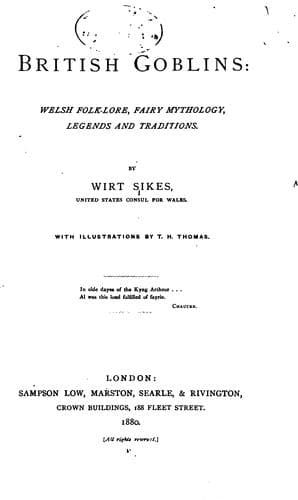
British Goblins: Welsh Folk-lore, Fairy Mythology, Legends and TraditionsSikes, Wirt
History
British Goblins: Welsh Folk-lore, Fairy Mythology, Legends and Traditions
Sikes, Wirt
Folklore -- Wales; Goblins -- Wales; Mythology, Celtic -- Wales; Mythology, Welsh; Wales -- Social life and customs
Familiar spirits of this class are not always invisible; and they can
assume such forms as may be necessary to serve their purposes. A
favourite shape with them is that of a young and lovely woman.
Comparisons are here suggested with the water-maidens, and other like
forms of this fancy; but they need not be pursued. It is necessary for
the student of phantoms to constantly remind himself of the
omnipresent danger of being enticed too far afield, unless he keep
somewhat sternly to the path he has marked out. How ancient is the
notion of a familiar spirit in female form, may be seen from accounts
which are given by Giraldus and other old writers. Near Caerleon,
(Monmouthshire,) in the twelfth century, Giraldus tells us[80] there
lived 'a Welshman named Melerius, who by the following means acquired
the knowledge of future events and the occult sciences: Having on a
certain night met a damsel whom he loved, in a pleasant and convenient
place, while he was indulging in her embraces, instead of a beautiful
girl he found in his arms a hairy, rough and hideous creature, the
sight of which deprived him of his senses; and after remaining many
years in this condition he was restored to health in the church of St.
David's, through the merits of its saints. But having always had an
extraordinary familiarity with unclean spirits, by seeing them,
knowing them, talking with them, and calling each by his proper name,
he was enabled through their assistance to foretell future events; he
was indeed often deceived (as they are) with respect to circumstances
at a great distance; but was less mistaken in affairs which were
likely to happen soon, or within the space of a year. They appeared to
him on foot, equipped as hunters, with horns suspended from their
necks, and truly as hunters not of animals but of souls; he
particularly met them near monasteries and religious places; for where
rebellion exists there is the greatest need of armies and strength. He
knew when any one spoke falsely in his presence, for he saw the devil
as it were leaping and exulting upon the tongue of the liar; and if he
looked into a book faultily or falsely written, although wholly
illiterate he would point out the place with his finger. Being
questioned how he could gain such knowledge, he said he was directed
by the demon's finger to the place.' In the same connection Giraldus
mentions a familiar spirit which haunted Lower Gwent, 'a demon
incubus, who from his love for a certain young woman, and frequenting
the place where she lived, often conversed with men, and frequently
discovered hidden things and future events.'
FOOTNOTE:
[80] Sir R. C. Hoare's Trans., i. 105.
IV.
Public-domain text, read in full here on John Shaqi.
Reviews
Reviews
No reviews yet
Be the first to share your thoughts on this work.
Elsewhere in the archive
Join the Discussion
Join the discussion
Sign in to leave a comment or review.
Sign InorCreate an account