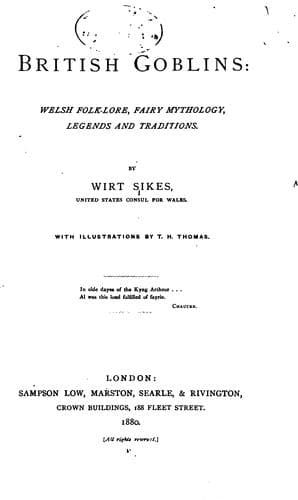
British Goblins: Welsh Folk-lore, Fairy Mythology, Legends and TraditionsSikes, Wirt
History
British Goblins: Welsh Folk-lore, Fairy Mythology, Legends and Traditions
Sikes, Wirt
Folklore -- Wales; Goblins -- Wales; Mythology, Celtic -- Wales; Mythology, Welsh; Wales -- Social life and customs
The frightful ugliness of the Gwrach y Rhibyn is a consistent feature
of the superstition, in both its forms; it recalls the Black Maiden
who came to Caerleon and liberated Peredur:[97] 'Blacker were her face
and her two hands than the blackest iron covered with pitch; and her
hue was not more frightful than her form. High cheeks had she, and a
face lengthened downwards, and a short nose with distended nostrils.
And one eye was of a piercing mottled gray, and the other was as black
as jet, deep-sunk in her head. And her teeth were long and yellow,
more yellow were they than the flower of the broom. And her stomach
rose from the breast-bone, higher than her chin. And her back was in
the shape of a crook, and her legs were large and bony. And her figure
was very thin and spare, except her feet and legs, which were of huge
size.' The Welsh word 'gwrach' means a hag or witch, and it has been
fancied that there is a connection between this word and the mythical
Avagddu,[98] whose wife the gwrach was.
The Gwrach y Rhibyn appears also as a river-spectre, in
Glamorganshire.
FOOTNOTES:
[96] 'Demonology and Witchcraft,' 351.
[97] 'Mabinogion,' 114.
[98] Avagddu means both hell and the devil, as our word Heaven means
both the Deity and his abode.
V.
A death-portent which is often confused with the Gwrach y Rhibyn, yet
which is rendered quite distinct by its special attributes, is the
Cyhyraeth. This is a groaning spirit. It is never seen, but the noise
it makes is no less terrible to the ear than the appearance of its
visible sister is to the eye. Among groaning spirits it is considered
to be the chief. The Prophet Jones succinctly characterises it as 'a
doleful, dreadful noise in the night, before a burying.' David
Prosser, of Llanybyther parish, 'a sober, sensible man and careful to
tell the truth,' once heard the Cyhyraeth in the early part of the
night, his wife and maid-servant being together in the house, and also
hearing it; and when it came opposite the window, it 'pronounced these
strange words, of no signification that we know of,' viz. '_Woolach!
Woolach!_' Some time afterward a funeral passed that way. The
judicious Joshua Coslet, who lived by the river Towy in
Carmarthenshire, testified that the Cyhyraeth is often heard there,
and that it is 'a doleful, disagreeable sound heard before the deaths
of many, and most apt to be heard before foul weather. The voice
resembles the groaning of sick persons who are to die; heard at first
at a distance, then comes nearer, and the last near at hand; so that
it is a threefold warning of death. It begins strong, and louder than
a sick man can make; the second cry is lower, but not less doleful,
but rather more so; the third yet lower, and soft, like the groaning
of a sick man almost spent and dying.' A person 'well remembering the
voice' and coming to the sick man's bed, 'shall hear his groans
exactly like' those which he had before heard from the Cyhyraeth. This
Public-domain text, read in full here on John Shaqi.
Reviews
Reviews
No reviews yet
Be the first to share your thoughts on this work.
Elsewhere in the archive
Join the Discussion
Join the discussion
Sign in to leave a comment or review.
Sign InorCreate an account