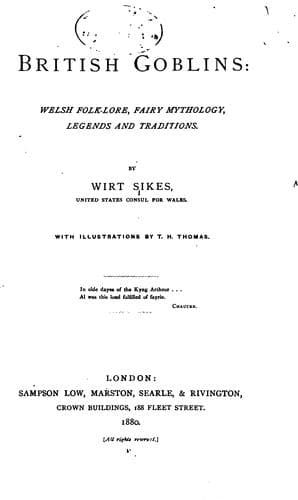
British Goblins: Welsh Folk-lore, Fairy Mythology, Legends and TraditionsSikes, Wirt
History
British Goblins: Welsh Folk-lore, Fairy Mythology, Legends and Traditions
Sikes, Wirt
Folklore -- Wales; Goblins -- Wales; Mythology, Celtic -- Wales; Mythology, Welsh; Wales -- Social life and customs
The Tolaeth Death Portent--Its various Forms--The Tolaeth
before Death--Ewythr Jenkin's Tolaeth--A modern
Instance--The Railway Victim's Warning--The Goblin
Voice--The Voice from the Cloud--Legend of the Lord and the
Beggar--The Goblin Funeral--The Horse's Skull--The Goblin
Veil--The Wraith of Llanllwch--Dogs of Hell--The Tale of
Pwyll--Spiritual Hunting Dogs--Origin of the Cwn Annwn.
I.
The Tolaeth is an ominous sound, imitating some earthly sound of one
sort or another, and always heard before either a funeral or some
dreadful catastrophe. Carpenters of a superstitious turn of mind will
tell you that they invariably hear the Tolaeth when they are going to
receive an order to make a coffin; in this case the sound is that of
the sawing of wood, the hammering of nails, and the turning of screws,
such as are heard in the usual process of making a coffin. This is
called the 'Tolaeth before the Coffin.' The 'Tolaeth before Death' is
a supernatural noise heard about the house, such as a knocking, or the
sound of footsteps in the dead of night. Sometimes it is the sound of
a tolling bell, where no bell is; and the direction in which the ear
is held at the time points out the place of the coming death. Formerly
the veritable church-bell in its steeple would foretell death, by
tolling thrice at the hour of midnight, unrung by human hands. The
bell of Blaenporth, Cardiganshire, was noted for thus warning the
neighbours. The 'Tolaeth before the Burying' is the sound of the
funeral procession passing by, unseen, but heard. The voices are
heard singing the 'Old Hundredth,' which is the psalm tune usually
sung by funeral bands; the slow regular tramp of the feet is heard,
and the sobbing and groaning of the mourners. The Tolaeth touches but
one sense at a time. When this funeral procession is heard it cannot
be seen. But it is a peculiarity of the Tolaeth that after it has been
heard by the ear, it sometimes makes itself known to the eye also--but
in silence. The funeral procession will at first be heard, and then if
the hearer stoop forward and look along the ground, it may perhaps be
seen; the psalm-singers, two abreast, with their hats off and their
mouths open, as in the act of singing; the coffin, borne on the
shoulders of four men who hold their hats by the side of their heads;
the mourners, the men with long black hatbands streaming behind, the
women pale and sorrowful, with upheld handkerchiefs; and the rest of
the procession stretching away dimly into shadow. Not a sound is
heard, either of foot or voice, although the singers' mouths are open.
After the procession has passed, and the observer has risen from his
stooping posture, the Tolaeth again breaks on the ear, the music, the
tread of feet, and the sobbing, as before. A real funeral is sure to
pass that way not long afterwards.
Public-domain text, read in full here on John Shaqi.
Reviews
Reviews
No reviews yet
Be the first to share your thoughts on this work.
Elsewhere in the archive
Join the Discussion
Join the discussion
Sign in to leave a comment or review.
Sign InorCreate an account