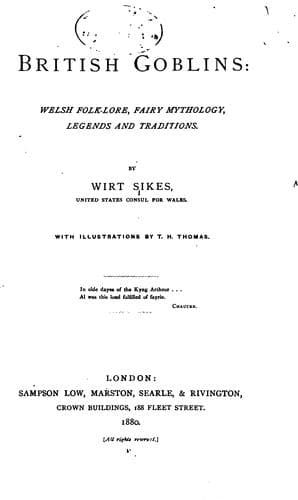
British Goblins: Welsh Folk-lore, Fairy Mythology, Legends and TraditionsSikes, Wirt
History
British Goblins: Welsh Folk-lore, Fairy Mythology, Legends and Traditions
Sikes, Wirt
Folklore -- Wales; Goblins -- Wales; Mythology, Celtic -- Wales; Mythology, Welsh; Wales -- Social life and customs
The pagan origin of most of our Christmas customs is undoubted. Even
the cheery Christmas-tree is a symbol of heathen rites in times long
antedating Christ. The early Christian fathers, in adopting the
popular usages of their predecessors, and bending them to the service
of Christianity, made wondrous little change in them, beyond the
substitution of new motives and names for the old festivals peculiar
to several seasons of the year. The British Druids' feast of Alban
Arthur, celebrating the new birth of the sun, occurred at our
Christmas time, and is still celebrated at Pontypridd, Glamorganshire,
every year. It begins on the 22nd of December, and lasts three days,
during which period the sun is supposed to fight with Avagddu, the
spirit of darkness, the great luminary having descended into hell for
that purpose. On the third day he rose, and the bards struck their
harps, rejoicing that the sun had again been found. The Pontypridd
ceremonies are similar to those of Midsummer-day, already mentioned.
The Arch-Druid presides in the folds of the serpent circle--when he
can get there, that is, for he is old, past eighty, and the Druidic
hill is apt to be slippery with snow and ice at this time of the year.
He prays to the pagan god, and perhaps chants a poem in Welsh.[133]
The Druidic fires of the winter solstice feast were continued in
customs like that which survived in Herefordshire until recent years,
when on old Christmas-eve thirteen fires were lighted in a cornfield,
twelve of them being in a circle round a central one which burned
higher than the rest. The circle fires were called the Twelve
Apostles, and the central one the Virgin Mary. In a shed near by was a
cow with a plum-cake between or upon her horns, into whose face a pail
of cider was dashed, with a rhyming address, and the cow tossing her
horns from her unexpected baptism naturally threw the plum-cake down.
If it fell forward, good harvests were predicted; if backward, the
omen was evil. A feast among the peasants followed. In the Plygain in
like manner survives the Druidic custom of going to the sacred groves
before dawn on this morning, to greet the rising of the new-born sun
after his struggle with the evil principle.
FOOTNOTE:
Public-domain text, read in full here on John Shaqi.
Reviews
Reviews
No reviews yet
Be the first to share your thoughts on this work.
Elsewhere in the archive
Join the Discussion
Join the discussion
Sign in to leave a comment or review.
Sign InorCreate an account