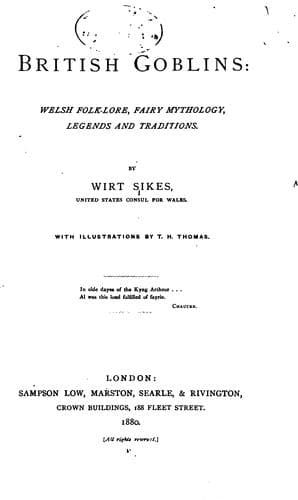
British Goblins: Welsh Folk-lore, Fairy Mythology, Legends and TraditionsSikes, Wirt
History
British Goblins: Welsh Folk-lore, Fairy Mythology, Legends and Traditions
Sikes, Wirt
Folklore -- Wales; Goblins -- Wales; Mythology, Celtic -- Wales; Mythology, Welsh; Wales -- Social life and customs
As far back as the 16th century, throwing an old shoe after any one
going on an important errand was deemed lucky in Wales. It is thought
that in the case of a bride, the custom is derived from the old Jewish
law of exchange, when a shoe was given in token that the parents for
ever surrendered all dominion over their daughter. But a precisely
similar custom prevails in China, where it is usual for the bride to
present her husband with a pair of shoes, by way of signifying that
for the future she places herself under his control. 'These are
carefully preserved in the family and are never given away, like other
worn-out articles, it being deemed, that to part with them portends an
early separation between husband and wife.'[138] The custom of
rice-throwing is also Chinese, the rice being viewed as a sign of
abundance. In Sicily, as in some parts of England, wheat is thrown on
the bride's head; in Russia, a handful of hops; in the north of
England a plateful of shortcake;[139] in Yorkshire, bits of the
bride-cake. All these customs, while popularly done 'for luck,' are
apparently symbolical of the obedience and the fruitfulness of the
newly-wedded wife. And as in Scandinavia the bride tries to get her
husband to pick up her handkerchief as an omen of his obeying instead
of compelling obedience, so in China the bride tries to sit on a part
of her husband's dress. The vulgar story and adage, 'Bandbox now,
bandbox always,' expresses the superstition succinctly.
There is a saying current on the Welsh border, that when rosemary
flourishes in the garden of a married pair, the lady 'rules the
roast,' as the phrase is--though if there is anything a woman should
rule, one would think the 'roast' is that thing. 'That be rosemary,
sir,' said an old gardener in Herefordshire, pointing to where the
plant grew; 'they say it grows but where the missus is master, and it
do grow here like wildfire.' The idea of feminine obedience to
masculine will, merely because it is masculine, is in itself looked
upon as a superstition by all cultivated people in these days, I
suppose. Sex aside, if the truth were known, it would be found that
the stronger is the ruler, in all lands, under all customs, be the
outward show of the ruling more or less; and it is not always where
the public sees it most clearly, or fancies it does, that the rule of
the dame is sternest. The strength here employed is not virile
strength; there is nothing necessarily masculine about it. The
severest mistress of her lord I ever knew was a feeble little woman
with hands like a baby's, and a face of wax, with no more will-power
apparently than a week-old kitten, but whose lightest whim lay on her
lord like iron, and was obeyed as faithfully as if it were backed by a
cat-o'-nine-tails and a six-shooter.
Public-domain text, read in full here on John Shaqi.
Reviews
Reviews
No reviews yet
Be the first to share your thoughts on this work.
Elsewhere in the archive
Join the Discussion
Join the discussion
Sign in to leave a comment or review.
Sign InorCreate an account