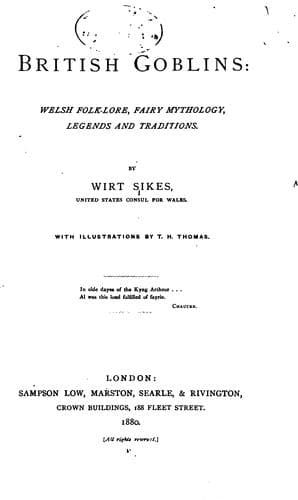
British Goblins: Welsh Folk-lore, Fairy Mythology, Legends and TraditionsSikes, Wirt
History
British Goblins: Welsh Folk-lore, Fairy Mythology, Legends and Traditions
Sikes, Wirt
Folklore -- Wales; Goblins -- Wales; Mythology, Celtic -- Wales; Mythology, Welsh; Wales -- Social life and customs
In all these legends the student of comparative folk-lore traces the
ancient mythology, however overlain with later details. The
water-maidens of every land doubtless originally were the floating
clouds of the sky, or the mists of the mountain. From this have come
certain fair and fanciful creations with which Indo-European folk-lore
teems, the most familiar of which are Undine, Melusina, Nausicaa, and
the classic Muse. In Wales, as in other lands, the myth has many
forms. The dispersion of dark clouds from the mountains, by the beams
of the rising sun, or the morning breezes, is localized in the legend
of the Men of Ardudwy. These men make a raid on the maidens of the
Vale of Clwyd, and are pursued and slaughtered by the latter's fathers
and brothers. The maidens thereupon cast themselves headlong into the
lake, which is thenceforth called the Maidens' Lake, or Llyn y
Morwynion. In another legend, the river mist over the Cynwal is the
spirit of a traitress who perished long ago in the lake. She had
conspired with the sea-born pirates of the North (the ocean storms) to
rob her Cambrian lord of his domains. She was defeated by the aid of a
powerful enchanter (the sun), and fled up the river to the lake,
accompanied by her maidens, who were drowned with her there.[29]
FOOTNOTE:
[29] 'Arch. Camb.,' 4th Se., vii., 251.
IX.
As the mermaid superstition is seemingly absent in Wales, so there are
no fairy tales of maidens who lure mortals to their doom beneath the
water, as the Dracæ did women and children, and as the Nymph of the
Lurley did marriageable young men. But it is believed that there are
several old Welsh families who are the descendants of the Gwragedd
Annwn, as in the case of the Meddygon Myddfai. The familiar Welsh name
of Morgan is sometimes thought to signify, 'Born of the Sea.'
Certainly môr in Welsh means sea, and gân a birth. It is curious,
too, that a mermaid is called in Basse Bretagne 'Mary Morgan.' But the
class of stories in which a mortal marries a water-maiden is large,
and while the local details smack of the soil, the general idea is so
like in lands far remote from each other as to indicate a common
origin in pre-historic times. In Wales, where the mountain lakes are
numerous, gloomy, lonely, and yet lovely; where many of them, too,
show traces of having been inhabited in ancient times by a race of
lake-dwellers, whose pile-supported villages vanished ages ago; and
where bread and cheese are as classic as beer and candles, these
particulars are localized in the legend. In the Faro Islands, where
the seal is a familiar yet ever-mysterious object, with its human-like
eyes, and glossy skin, the wife of supernatural race is a transformed
seal. She comes ashore every ninth night, sheds her skin, leaves it on
the shore, and dances with her fairy companions. A mortal steals her
sealskin dress, and when day breaks, and her companions return to
their abode in the sea, compels her to remain and be his wife. Some
Public-domain text, read in full here on John Shaqi.
Reviews
Reviews
No reviews yet
Be the first to share your thoughts on this work.
Join the Discussion
Join the discussion
Sign in to leave a comment or review.
Sign InorCreate an account