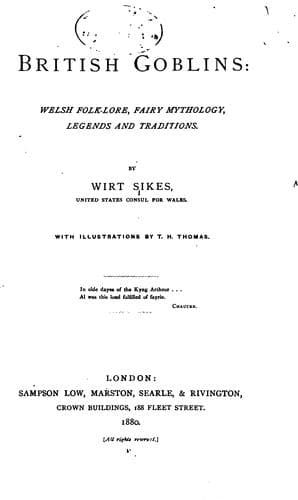
British Goblins: Welsh Folk-lore, Fairy Mythology, Legends and TraditionsSikes, Wirt
History
British Goblins: Welsh Folk-lore, Fairy Mythology, Legends and Traditions
Sikes, Wirt
Folklore -- Wales; Goblins -- Wales; Mythology, Celtic -- Wales; Mythology, Welsh; Wales -- Social life and customs
day he offends her; she recovers her skin and plunges into the sea. In
China, the superstition appears in a Lew-chewan legend mentioned by
Dr. Dennys,[30] which relates how a fairy in the guise of a beautiful
woman is found bathing in a man's well. He persuades her to marry him,
and she remains with him for nine years, at the end of which time,
despite the affection she has for their two children, she 'glides
upwards into a cloud' and disappears.
FOOTNOTE:
[30] 'Folk-Lore of China,' 99.
CHAPTER IV.
Mountain Fairies--The Gwyllion--The Old Woman of the
Mountain--The Black Mountain Gwyll--Exorcism by
Knife--Occult Intellectual Powers of Welsh Goats--The Legend
of Cadwaladr's Goat.
I.
The Gwyllion are female fairies of frightful characteristics, who
haunt lonely roads in the Welsh mountains, and lead night-wanderers
astray. They partake somewhat of the aspect of the Hecate of Greek
mythology, who rode on the storm, and was a hag of horrid guise. The
Welsh word gwyll is variously used to signify gloom, shade, duskiness,
a hag, a witch, a fairy, and a goblin; but its special application is
to these mountain fairies of gloomy and harmful habits, as distinct
from the Ellyllon of the forest glades and dingles, which are more
often beneficent. The Gwyllion take on a more distinct individuality
under another name--as the Ellyllon do in mischievous Puck--and the
Old Woman of the Mountain typifies all her kind. She is very carefully
described by the Prophet Jones,[31] in the guise in which she haunted
Llanhiddel Mountain in Monmouthshire. This was the semblance of a poor
old woman, with an oblong four-cornered hat, ash-coloured clothes, her
apron thrown across her shoulder, with a pot or wooden can in her
hand, such as poor people carry to fetch milk with, always going
before the spectator, and sometimes crying 'Wow up!' This is an
English form of a Welsh cry of distress, 'Wwb!' or 'Ww-bwb!'[32]
Those who saw this apparition, whether by night or on a misty day,
would be sure to lose their way, though they might be perfectly
familiar with the road. Sometimes they heard her cry, 'Wow up!' when
they did not see her. Sometimes when they went out by night, to fetch
coal, water, etc., the dwellers near that mountain would hear the cry
very close to them, and immediately after they would hear it afar off,
as if it were on the opposite mountain, in the parish of Aberystruth.
The popular tradition in that district was that the Old Woman of the
Mountain was the spirit of one Juan White, who lived time out of mind
in those parts, and was thought to be a witch; because the mountains
were not haunted in this manner until after Juan White's death.[33]
When people first lost their way, and saw her before them, they used
to hurry forward and try to catch her, supposing her to be a
flesh-and-blood woman, who could set them right; but they never could
overtake her, and she on her part never looked back; so that no man
ever saw her face.
Public-domain text, read in full here on John Shaqi.
Reviews
Reviews
No reviews yet
Be the first to share your thoughts on this work.
Join the Discussion
Join the discussion
Sign in to leave a comment or review.
Sign InorCreate an account