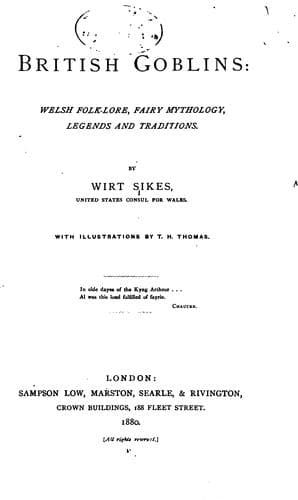
British Goblins: Welsh Folk-lore, Fairy Mythology, Legends and TraditionsSikes, Wirt
History
British Goblins: Welsh Folk-lore, Fairy Mythology, Legends and Traditions
Sikes, Wirt
Folklore -- Wales; Goblins -- Wales; Mythology, Celtic -- Wales; Mythology, Welsh; Wales -- Social life and customs
[41] Sion and Shon are the same word, just as are our Smith and Smyth.
Where there are so few personal names as in Wales, while I would not
myself change a single letter in order to render the actors in a tale
more distinct, it is perhaps as well to encourage any eccentricities
of spelling which we are so lucky as to find on the spot.
VIII.
Ignorance of what transpired in the fairy circle is not an invariable
feature of legends like those we have been observing. In the story of
Tudur of Llangollen, preserved by several old Welsh writers, the
hero's experiences are given with much liveliness of detail. The scene
of this tale is a hollow near Llangollen, on the mountain side
half-way up to the ruins of Dinas Bran Castle, which hollow is to this
day called Nant yr Ellyllon. It obtained its name, according to
tradition, in this wise: A young man, called Tudur ap Einion Gloff,
used in old times to pasture his master's sheep in that hollow. One
summer's night, when Tudur was preparing to return to the lowlands
with his woolly charge, there suddenly appeared, perched upon a stone
near him, 'a little man in moss breeches with a fiddle under his arm.
He was the tiniest wee specimen of humanity imaginable. His coat was
made of birch leaves, and he wore upon his head a helmet which
consisted of a gorse flower, while his feet were encased in pumps made
of beetle's wings. He ran his fingers over his instrument, and the
music made Tudur's hair stand on end. "Nos da'ch', nos da'ch'," said
the little man, which means "Good-night, good-night to you," in
English. "Ac i chwithau," replied Tudur; which again, in English,
means "The same to you." Then continued the little man, "You are fond
of dancing, Tudur; and if you but tarry awhile you shall behold some
of the best dancers in Wales, and I am the musician." Quoth Tudur,
"Then where is your harp? A Welshman even cannot dance without a
harp." "Oh," said the little man, "I can discourse better dance music
upon my fiddle." "Is it a fiddle you call that stringed wooden spoon
in your hand?" asked Tudur, for he had never seen such an instrument
before. And now Tudur beheld through the dusk hundreds of pretty
little sprites converging towards the spot where they stood, from all
parts of the mountain. Some were dressed in white, and some in blue,
and some in pink, and some carried glow-worms in their hands for
torches. And so lightly did they tread that not a blade nor a flower
was crushed beneath their weight, and every one made a curtsey or a
bow to Tudur as they passed, and Tudur doffed his cap and moved to
them in return. Presently the little minstrel drew his bow across the
strings of his instrument, and the music produced was so enchanting
that Tudur stood transfixed to the spot.' At the sound of the sweet
melody, the Tylwyth Teg ranged themselves in groups, and began to
dance. Now of all the dancing Tudur had ever seen, none was to be
compared to that he saw at this moment going on. He could not help
Public-domain text, read in full here on John Shaqi.
Reviews
Reviews
No reviews yet
Be the first to share your thoughts on this work.
Elsewhere in the archive
Join the Discussion
Join the discussion
Sign in to leave a comment or review.
Sign InorCreate an account