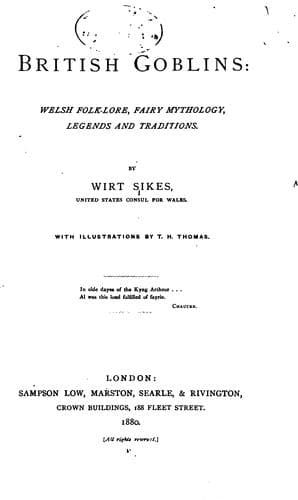
British Goblins: Welsh Folk-lore, Fairy Mythology, Legends and TraditionsSikes, Wirt
History
British Goblins: Welsh Folk-lore, Fairy Mythology, Legends and Traditions
Sikes, Wirt
Folklore -- Wales; Goblins -- Wales; Mythology, Celtic -- Wales; Mythology, Welsh; Wales -- Social life and customs
A Carmarthenshire tradition names among those who lived for a period
among the Tylwyth Teg no less a person than the translator into Welsh
of Bunyan's 'Pilgrim's Progress.' He was called Iago ap Dewi, and
lived in the parish of Llanllawddog, Carmarthenshire, in a cottage
situated in the wood of Llangwyly. He was absent from the
neighbourhood for a long period, and the universal belief among the
peasantry was that Iago 'got out of bed one night to gaze on the
starry sky, as he was accustomed (astrology being one of his favourite
studies), and whilst thus occupied the fairies (who were accustomed to
resort in a neighbouring wood), passing by, carried him away, and he
dwelt with them seven years. Upon his return he was questioned by many
as to where he had been, but always avoided giving them a reply.'
XIII.
The wide field of interest opened up in tales of this class is a
fascinating one to the students of fairy mythology. The whole world
seems to be the scene of such tales, and collectors of folk-lore in
many lands have laid claim to the discovery of 'the original' on
which the story of Rip van Winkle is based. It is an honour to
American genius, to which I cannot forbear a passing allusion, that of
all these legends, none has achieved so wide a fame as that which
Washington Irving has given to our literature, and Joseph Jefferson to
our stage. It is more than probable that Irving drew his inspiration
from Grimm, and that the Catskills are indebted to the Hartz Mountains
of Germany for their romantic fame. But the legends are endless in
which occur this unsuspected lapse of time among supernatural beings,
and the wandering back to the old home to find all changed. In Greece,
it is Epimenides, the poet, who, while searching for a lost sheep,
wanders into a cave where he slumbers forty-seven years. The Gaelic
and Teutonic legends are well known. But our wonder at the vitality of
this myth is greatest when we find it in both China and Japan. In the
Japanese account a young man fishing in his boat on the ocean is
invited by the goddess of the sea to her home beneath the waves. After
three days he desires to see his old mother and father. On parting she
gives him a golden casket and a key, but begs him never to open it. At
the village where he lived he finds that all is changed, and he can
get no trace of his parents until an aged woman recollects having
heard of their names. He finds their graves a hundred years old.
Thinking that three days could not have made such a change, and that
he was under a spell, he opens the casket. A white vapour rises, and
under its influence the young man falls to the ground. His hair turns
grey, his form loses its youth, and in a few moments he dies of old
age. The Chinese legend relates how two friends wandering amongst the
ravines of their native mountains in search of herbs for medicinal
purposes, come to a fairy bridge where two maidens of more than
earthly beauty are on guard.
Public-domain text, read in full here on John Shaqi.
Reviews
Reviews
No reviews yet
Be the first to share your thoughts on this work.
Elsewhere in the archive
Join the Discussion
Join the discussion
Sign in to leave a comment or review.
Sign InorCreate an account