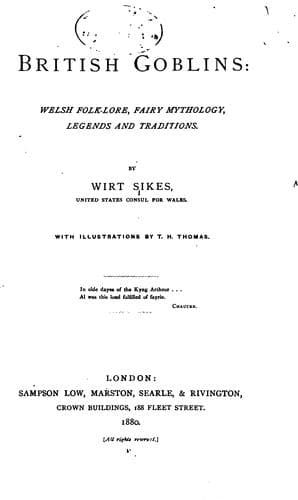
British Goblins: Welsh Folk-lore, Fairy Mythology, Legends and TraditionsSikes, Wirt
History
British Goblins: Welsh Folk-lore, Fairy Mythology, Legends and Traditions
Sikes, Wirt
Folklore -- Wales; Goblins -- Wales; Mythology, Celtic -- Wales; Mythology, Welsh; Wales -- Social life and customs
'Look at the pretty
clothes the children gave me on the mountain, for dancing with them to
the music of their harps.' With this he opened his bundle, and showed
a handsome dress; and behold, it was only paper, like the fairy money.
FOOTNOTE:
[59] 'Winter's Tale,' Act III., Sc. 3.
II.
But usually, throughout Wales, it is simply a discontinuance of fairy
favour which follows blabbing. A legend is connected with a bridge in
Anglesea, of a lad who often saw the fairies there, and profited by
their generosity. Every morning, while going to fetch his father's
cows from pasture, he saw them, and after they were gone he always
found a groat on a certain stone of Cymmunod Bridge. The boy's having
money so often about him excited his father's suspicion, and one
Sabbath day he cross-questioned the lad as to the manner in which it
was obtained. Oh, the meddlesomeness of fathers! Of course the poor
boy confessed that it was through the medium of the fairies, and of
course, though he often went after this to the field, he never found
any money on the bridge, nor saw the offended Tylwyth Teg again.
Through his divulging the secret their favour was lost.
Jones tells a similar story of a young woman named Anne William
Francis, in the parish of Bassalleg, who on going by night into a
little grove of wood near the house, heard pleasant music, and saw a
company of fairies dancing on the grass. She took a pail of water
there, thinking it would gratify them. The next time she went there
she had a shilling given her, 'and so had for several nights after,
until she had twenty-one shillings.' But her mother happening to find
the money, questioned her as to where she got it, fearing she had
stolen it. At first the girl would not tell, but when her mother 'went
very severe on her,' and threatened to beat her, she confessed she got
the money from the fairies. After that they never gave her any more.
The Prophet adds: 'I have heard of other places where people have had
money from the fairies, sometimes silver sixpences, but most commonly
copper coin. As they cannot make money, it certainly must be money
lost or concealed by persons.' The Euhemerism of this is hardly like
the wonder-loving Jones.
III.
Public-domain text, read in full here on John Shaqi.
Reviews
Reviews
No reviews yet
Be the first to share your thoughts on this work.
Elsewhere in the archive
Join the Discussion
Join the discussion
Sign in to leave a comment or review.
Sign InorCreate an account