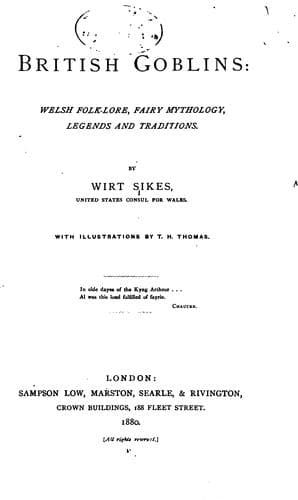
British Goblins: Welsh Folk-lore, Fairy Mythology, Legends and TraditionsSikes, Wirt
History
British Goblins: Welsh Folk-lore, Fairy Mythology, Legends and Traditions
Sikes, Wirt
Folklore -- Wales; Goblins -- Wales; Mythology, Celtic -- Wales; Mythology, Welsh; Wales -- Social life and customs
As a rule, the motive for the reappearance on earth of a spirit lately
tenanting a mortal body, is found in some neglected duty. The spirit
of a suicide is morally certain to walk: a reason why suicides are so
unpopular as tenants of graveyards. It is a brave man who will go to
the grave of a suicide and play 'Hob y deri dando' on the ysturmant
(jew's-harp), without missing a note. Many are the tales displaying
the motive, on the ghost's part, of a duty to perform--sometimes
clearly defining it, sometimes vaguely suggesting it, as in the story
of Noe. 'The evening was far gone when a traveller of the name of Noe
arrived at an inn in Pembrokeshire, and called for refreshment. After
remaining some time he remarked that he must proceed on his journey.
"Surely," said the astonished landlord, "you will not travel at night,
for it is said that a ghost haunts that road, crying out, The days are
long and the nights are cold to wait for Noe." "O, I am the man sought
for," said he, and immediately departed; but strange to say, neither
Noe nor the ghost was ever heard of afterwards.'[66]
The ghost of a weaver, which appeared to Walter John Harry, had a very
clear idea of the duty he must perform: Walter John Harry was a
Quaker, a harmless, honest man, and by trade a farrier, who lived in
the romantic valley of Ebwy Fawr. The house he lived in was haunted by
the ghost of Morgan Lewis, a weaver, who had died in that house. One
night, while lying awake in his bed, with his wife sleeping by his
side, Harry saw a light slowly ascending the stairs, and being
somewhat afraid, though he was naturally a fearless man, strove to
awake his wife by pinching her, but could not awake her. So there he
lay in great fear, and with starting eyes beheld the ghost of the
weaver come up the stairs, bearing a candle in its hand, and wearing a
white woollen cap on its head, with other garments usual to the weaver
when alive. The ghost came near the farrier's bed, who then mustered
up courage to speak to it. 'Morgan Lewis,' said Harry, 'why dost thou
walk this earth?' The ghost replied with great solemnity, that its
reason for so doing was that there were some 'bottoms of wool' hidden
in the wall of this house, and until these said bottoms were removed
from the wall it could not sleep. The ghost did not say this wool had
been stolen, but such was the inference. However, the harmless farrier
spoke severely to the ghost, saying, 'I charge thee, Morgan Lewis, in
the name of God, that thou trouble my house no more.' Whereupon the
ghost vanished, and the house ceased thereafter to be haunted.
Public-domain text, read in full here on John Shaqi.
Reviews
Reviews
No reviews yet
Be the first to share your thoughts on this work.
Elsewhere in the archive
Join the Discussion
Join the discussion
Sign in to leave a comment or review.
Sign InorCreate an account