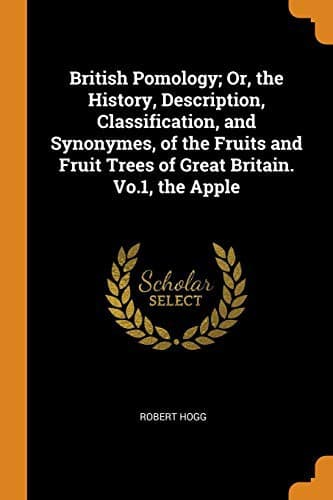
British Pomology: Or, the History, Description, Classification, and Synonymes, of the Fruits and Fruit Trees of Great BritainHogg, Robert
History
British Pomology: Or, the History, Description, Classification, and Synonymes, of the Fruits and Fruit Trees of Great Britain
Hogg, Robert
Apples
FIGURES.--Pom. Mag. t. 17. Ron. Pyr. Mal. pl. i. f. 6.
Fruit, small, two inches and a half wide, and two inches and a quarter
high; ovate, regularly and handsomely shaped. Skin, clear bright
yellow, tinged and mottled with red on the side exposed to the sun,
and strewed with numerous pearly specks. Eye, small, set in a wide and
even basin. Stalk, short and slender, inserted in a small and shallow
cavity. Flesh, yellowish, firm, juicy, and highly flavored.
A dessert apple of first-rate quality; in use during October and
November.
This excellent little apple was raised by Thomas Andrew Knight, Esq.,
from the seed of the Orange Pippin impregnated with the Golden Pippin,
about the year 1800. It, and the Yellow Ingestrie, were the produce of
two pips taken from the same cell of the core. The original trees are
still in existence at Wormsley Grange, in Herefordshire.
287. RED-MUST.--Evelyn.
IDENTIFICATION.--Evelyn Pom. Worl. Vin. 162. Pom. Heref. Lind. Guide,
109.
FIGURE.--Pom. Heref. t. 4.
Fruit, nearly, if not quite, the largest cider apple cultivated in
Herefordshire. It is rather broad and flattened, a little irregular at
its base, which is hollow. Stalk, slender. Crown, sunk. Eye, deep, with
a stout erect calyx. Skin, greenish-yellow on the shaded side, with
a deep rosy color where exposed to the sun, and shaded with a darker
red.--_Lindley._
The Red Must has at all periods been esteemed a good cider apple,
though the ciders lately made with it, unmixed with other apples, have
been light, and thin; and I have never found the specific gravity of
its expressed juice to exceed 1064.--_Knight._
288. RED-STREAK.--Evelyn.
IDENTIFICATION.--Evelyn Pom. Worl. Vin. 164. Nourse Camp. Fel. 143.
Fors. Treat. 123. Lind. Guide, 110. Pom. Heref. t. 1. Down. Fr. Amer.
146.
SYNONYMES.--Herefordshire Red-Streak, _Hort. Soc. Cat._ ed. 3, n. 625.
Scudamore’s Crab.
FIGURES.--Pom. Heref. t. 1. Brook. Pom. Brit. pl. xciii. f. 4.
Fruit, medium sized, two inches and three quarters wide, and two inches
and a quarter high; roundish, narrowing towards the apex. Skin, deep
clear yellow, streaked with red on the shaded side; but red, streaked
with deeper red on the side next the sun. Eye, small, with convergent
segments, set in a rather deep basin. Stalk, short and slender. Flesh,
yellow, firm, crisp, and rather dry.
Specific gravity of the juice, 1079.
A cider apple, which at one period was unsurpassed, but now
comparatively but little cultivated.
Perhaps there is no apple which at any period created such a sensation,
and of which so much was said and written during the 17th century, as
of the Red Streak. Prose and verse were both enlisted in its favor.
It was chiefly by the writings of Evelyn it attained its greatest
celebrity. Philips, in his poem--_Cyder_, says
Public-domain text, read in full here on John Shaqi.
Reviews
Reviews
No reviews yet
Be the first to share your thoughts on this work.
Elsewhere in the archive
Join the Discussion
Join the discussion
Sign in to leave a comment or review.
Sign InorCreate an account