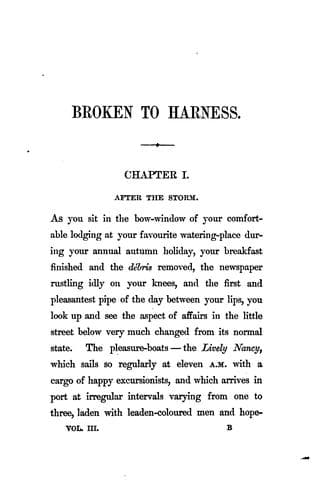
Broken to Harness: A Story of English Domestic LifeYates, Edmund
General
Broken to Harness: A Story of English Domestic Life
Yates, Edmund
England -- Fiction
An infatuated fellow, this Frank Churchill; so happy in the possession
of his wife, in the knowledge that she was his own, all his own, that
nothing, not even the fact that she was occasionally a "little low,"
had power to damp his happiness for more than a very few minutes. He
would sit at dinner of an evening, when she was engaged with her work,
and he had a book in front of him, in company, when he could steal a
minute from the general conversation, looking at her in rapt
admiration; not one point of her beauty was lost upon him; the shape
of her head; its _pose_ on her neck; her delicate hands with that pink
shell-like palm; those long tapering fingers and filbert nails; her
rounded bust and slim waist,--all her special excellences impressed
him more now than they had when he had first seen her; but, above all,
he revelled in her "bred" appearance, in that indefinable something
which seemed to lift her completely out of the set of people with
which he saw her surrounded, and to show her by right the denizen of
another sphere. If you could have persuaded Frank Churchill that
another man held such opinions as these; that another man had such
feelings with regard to his wife; and that through holding them he was
induced to regard somewhat intolerantly those among whom he had
hitherto moved, and from whom he had received the greatest kindness
and friendship,--what words would have been scathing enough to have
expressed Frank Churchill's disgust!
Yet such was undoubtedly the case. Churchill's most intimate friend
was George Harding,--a man whom he reverenced and looked up to, but
whom he, since his marriage, had often found himself pitying from the
bottom of his soul. Not on his own account: loyal to his craft and
steadfast in his friendship, Churchill thought there were few more
desirable positions than the editorship of the _Statesman_, when as
free from influence or partisanship as when Harding held the berth. It
was because his friend was Mrs. Harding's husband that Churchill
pitied him; though, indeed, Mrs. Harding was a very fair average kind
of woman. A dowdy little person, Mrs. Harding! the daughter of a
snuffy Welsh rector, who had written a treatise on "Aorists," and with
whom Harding had read one long vacation,--a round-faced old-maidish
little woman, classically brought up, who could construe Cicero
fluently, and looked upon Horace (Q. Flaccus, I mean) as rather a
loose personage. In the solitude of Plas-y-dwdllem, George Harding was
thrown into the society of this young female. He did not fall in love
with her--they were neither of them capable of any thing violent of
that nature; but--I am reduced to the phraseology of the servants'
hall to express my meaning--they "kept company together;" and when
George took his degree and started in life as leader-writer for the
_Morning Cracker_ (long since defunct), he thought the best thing he
could do for his comfort was to go for a run to Wales and bring back
Sophia Evans as his wife.
Public-domain text, read in full here on John Shaqi.
Reviews
Reviews
No reviews yet
Be the first to share your thoughts on this work.
Elsewhere in the archive
Join the Discussion
Join the discussion
Sign in to leave a comment or review.
Sign InorCreate an account