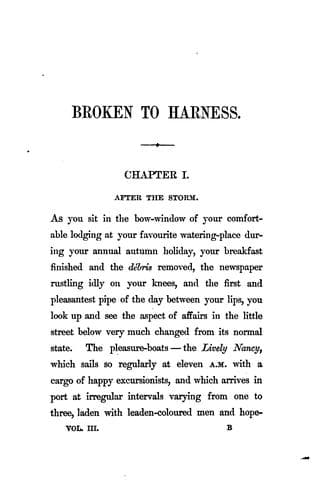
Broken to Harness: A Story of English Domestic LifeYates, Edmund
General
Broken to Harness: A Story of English Domestic Life
Yates, Edmund
England -- Fiction
"How _very_ nice! What an old dear you are, Dunster!" said a gentleman
sitting in a corner of the fireplace exactly opposite Barbara, with
his legs stretched out on a stool, and his body reclining on an
easy-chair. This was Mr. Lacy, an artist, who, as it was, made a very
good income, but who might have taken the highest rank had his
perseverance been on a par with his talent; a sleepy, dreamy man, with
an intense appreciation of and regard for himself.
"What do you think of all this, Mrs. Churchill?" asked Bloss; "they
are any thing but compassionate in their remarks."
"They may be or not," said Barbara, wearily. "It is all Greek to me:
while these gentlemen talk what I believe is called 'shop,' I am
utterly unable to follow the conversation."
Frank looked uneasily across at his wife, but said nothing.
"What shall we talk about, Mrs. Churchill?" said Mr. Dunster, with an
evil twinkle of his blue eyes. "Shall it be the last ball in the
Belgravia, or the new _jupe_; how Mario sang in the _Prophète_, or
whether bonnets will be worn on or off the head?"
Churchill frowned at this remark, but his brow cleared as Barbara said
with curling lip:
"You need not go so far for illustrations of what you don't
understand, Mr. Dunster. Let us discuss tolerance, domestic
enjoyments, or the pleasure of being liked by any one,--all of which
axe, I am sure, equally strange to you."
Mr. Dunster winced, and the fire faded out of his blue eyes: he did
not understand being bearded. Frank Churchill, though astonished at
seeing his wife defiant, was by no means displeased. Old Mr. Lacy,
fearing a storm, which would have ruffled him sadly, struck in at
once:
"It's a mistake, my dear Churchill; I'm convinced of it. We're not fit
for these charming creatures, we artists and writers, believe me.
We're a deucedly irritable, growling, horrible set of ruffians, who
ought to be left, like a lot of Robinson Crusoes, each on a separate
island. I can fully enter into Mrs. Churchill's feelings; and I've no
doubt that Mrs. Lacy feels exactly the same. But what do I do? I'm
compelled to shut the door in Mrs. Lacy's face--to lock Mrs. Lacy out.
She's a most excellent woman, as you know, Churchill; but she always
wants to talk to me when I ought to be at work; now, on a sky-day, for
instance! There are very few days in the year in this detestable
climate, my dear Mrs. Churchill, which permit of one's seeing the sky
sufficiently to paint it. When such a day does happen, I go to my
studio and lock the door; but I've scarcely set my palette, before
they come and rap, and want to talk to me--to ask me about the
butcher, or to tell me about the nurse's sister, or something; and I'm
obliged to whistle or sing to prevent my hearing 'em, or I should get
interested about the nurse's sister, and open the door, and then my
day's work would be spoilt."
"You're right, Lacy," said Dunster: "men who've got work to do should
remain single. They'll never--"
Public-domain text, read in full here on John Shaqi.
Reviews
Reviews
No reviews yet
Be the first to share your thoughts on this work.
Elsewhere in the archive
Join the Discussion
Join the discussion
Sign in to leave a comment or review.
Sign InorCreate an account