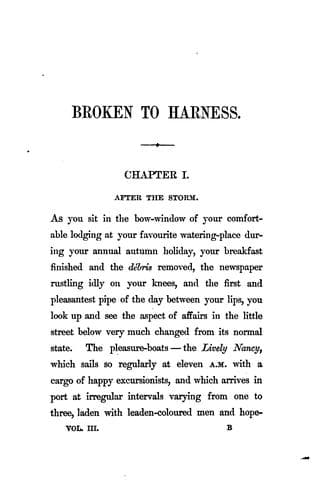
Broken to Harness: A Story of English Domestic LifeYates, Edmund
General
Broken to Harness: A Story of English Domestic Life
Yates, Edmund
England -- Fiction
Two days after the events recorded in the last chapter, Mr. Simnel
left the Tin-Tax Office a couple of hours earlier than his usual time
of departure, and taking a cab, hurried off to his apartments in
Piccadilly. Overlooking the Green Park, sufficiently lofty to be
removed from the immediate noise of the traffic, and situate in that
part of the street which was macadamised, there were, perhaps, no more
delightful chambers in town than those occupied by the Tin-Tax
secretary. They consisted but of three rooms--sitting-room,
bed-chamber, and bath-room; but all were lofty and well-proportioned,
and were furnished in a thoroughly luxurious manner. A big bookcase,
with its contents admirably selected, covered one side of the
sitting-room, on the walls of which hung Raphael Morghen prints, and
before-letter proofs after Landseer, Leslie, and Stanfield; a round
table, over which were suspended three swinging moderator-lamps, with
white-china shades and crimson-silk fringe; a sofa and numerous
easy-chairs, all in crimson velvet and walnut-wood; rich spoils of
Bohemian glass, standing in odd corners on quaint oak cabinets; two
Sèvres china dogs, in begging attitude, mounting guard on either end
of the mantelshelf; and a flying female figure suspended across the
looking-glass;--such were among the incongruous contents of the room.
On the table, two yellow-paper covered French novels, a Horace,
and M'Culloch's Commercial Directory lay side by side; in the
looking-glass, cards for evening-parties and dinners were jostled by
tickets soliciting vote and interest in approaching elections of
charitable societies, remindings of gatherings of learned bodies, and
small bills for books or boots. It was Mr. Simnel's pleasure to keep
up this _mélange_; his time was generally fully occupied; he chose
people to consider that he had not a moment to himself; he wished
those who called on him on business to see the invitations, in order
that they might judge therefrom of his position in society; and he
took care that the attention of those idle droppers-in, who came on a
Sunday morning, for instance, or late at night, to have a chat, should
be directed to the business-cards, to give them a notion of his
standing in the money-making, business world. Since Mr. Simnel assumed
the reins at the Tin-Tax Office, two or three hundred men had sat with
their legs under that round table, discussing an excellent dinner, and
meeting pleasant people; but not one of them had ever left the room
without Mr. Simnel's feeling that his coming had been productive of
benefit to his host, and that the invitation had fully answered its
intent. Baron Oppenhardt, the great financier, never could tell what
made him accept Simnel's invitation, save that he knew his host was
connected with Government and had a long head of his own; yet he never
refused. And little Blurt, whose "connexion with the press" was of a
limited nature, never could understand why, biennially, he sat under
Public-domain text, read in full here on John Shaqi.
Reviews
Reviews
No reviews yet
Be the first to share your thoughts on this work.
Elsewhere in the archive
Join the Discussion
Join the discussion
Sign in to leave a comment or review.
Sign InorCreate an account