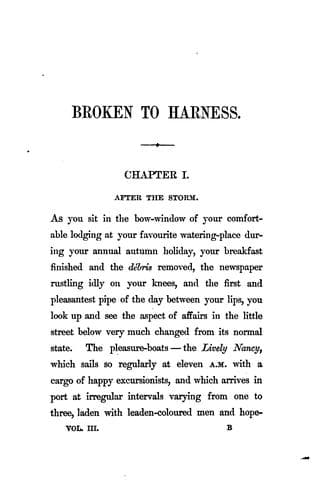
Broken to Harness: A Story of English Domestic LifeYates, Edmund
General
Broken to Harness: A Story of English Domestic Life
Yates, Edmund
England -- Fiction
For some few months after the events just described, the lives of
those who form the characters of this little drama passed evenly on
without the occurrence of any circumstance worthy of special record on
the part of their historian. Mr. Beresford, implicitly following Mr.
Simnel's advice, proceeded to lay siege to Mrs. Schröder in the manner
agreed upon, and found his advances received very much after the
fashion predicted by his astute friend. In all child-like simplicity
Mrs. Schröder firmly believed in the baneful influence which she had
unconsciously exercised over her admirer, and strove to make him
amends by a charitable and sentimental pity. She could perfectly
appreciate all his feelings; for was not she herself misunderstood?
had her girlhood's dream been realised? what was wealth, what was
position, to her? was she not mated with one who, &c.? So she not
merely permitted but encouraged Mr. Beresford's fraternal sentiments;
though she by no means eschewed the world and its frivolity, and gave
herself up to solitary romance. On the contrary, she went out a great
deal into society, and had frequent receptions at home; Beresford
being her constant but always unobtrusive companion. It is difficult
to say what motive about this time prompted a considerable change in
Mr. Schröder's manner towards his wife; but some such change
undoubtedly took place. It may possibly have been that the
insufficiency of money as a source of happiness may have dawned upon
him, steeped as he was to his very lips in constantly-increasing
wealth. It may have been that he suddenly awoke to the fact that he
was expected to lavish something more than generosity on the young
girl whom he had made the head of his house, and who, as he thought,
conducted herself with so much propriety. This new feeling may have
had its germ one night when they were sitting in their grand-tier box
at the Italian Opera, during the performance of _Der Freischütz_; and
as the old familiar strains rang through the house, Gustav Schröder's
memory travelled back for five-and-thirty years, and he saw himself a
lad of seventeen, seated in the pit of a little German theatre by the
side of a plump little girl, who wore a silver arrow through the great
knot of her flaxen hair, and down whose cheeks tears were rolling as
she listened to the recital of Agatha's woes. He had loved that plump
little Kätchen, loved her with a boy's pure and ardent passion; and
when sent to his uncle's counting-house at Frankfort, they had parted
with bitter tears, and with the exchange of very cheap and worthless
love-tokens. He wondered what had become of that five-groschen piece
with the hole drilled through it, and the bit of red ribbon. He
wondered why he had never loved since those days. And then he looked
up and saw his pretty, elegant little wife, whom every one admired and
praised; and it flashed upon him that he had never tried to break
through the outer crust of staid formality with which business and the
Public-domain text, read in full here on John Shaqi.
Reviews
Reviews
No reviews yet
Be the first to share your thoughts on this work.
Elsewhere in the archive
Join the Discussion
Join the discussion
Sign in to leave a comment or review.
Sign InorCreate an account