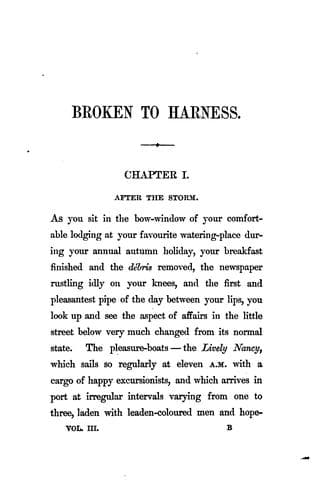
Broken to Harness: A Story of English Domestic LifeYates, Edmund
General
Broken to Harness: A Story of English Domestic Life
Yates, Edmund
England -- Fiction
Were these assertions correct? I fear that at all events they had a
certain proportion of truth. The spirit which had induced Barbara
Lexden to marry a man without money, and of, as her friends thought,
inferior position; which had made her scorn the threats of being cast
off by those among whom her life had hitherto been placed, and to hold
to one whom she knew but little, yet trusted much,--this same spirit
made her brave the fate to which she had resigned herself, and
determined that if she repined, it should be in secret and unheard. It
_was_ a mistake; _that_ she had already confessed to herself with
bitter tears many and many a time; done in haste, repented at
leisure--the old, old story, the old seductive myth, which will find
believers for ever and aye. How often, brooding in the solitude of her
chamber, had she gone over the whole business in her mind, linking bit
to bit, and endeavouring to find out where the reality had fallen short
of the anticipation!
They were poor. Well! had she not expected poverty; had not Frank told
her plainly and honourably of his position before he made any
declaration? Yes; but she did not understand poverty exactly as she
had found it. She knew that they would not be able to give parties,
nor to go to the Opera, nor that kind of thing; but she certainly
thought that they would go out sometimes, and that she should not be
stuck at home for ever. Of course the people who gave parties had a
great deal of expense; but those who went to them had none; and it was
not expected that any newly-married people living in a small way
should entertain in return. But then Frank, after positively refusing
to go out a third night running, had given way; but had shaken his
head, and looked so serious over a glove-bill which he happened to see
on her dressing-table, that she threw on her dressing-gown, and bade
him go by himself. She did not care about going out; but if she went,
she would be decent; she had always been considered to have a
reputation for good taste, and nothing on earth should make her a
dowdy now. She would sooner stay at home always; indeed there was
little enough to go out for, having to be jolted in those horrible
cabs, that crawled along the streets, with no room for one's dress,
and with the certainty of being covered with dust or straw, or some
dreadful stuff, when you got out; and then the insolence of the
driver!
Public-domain text, read in full here on John Shaqi.
Reviews
Reviews
No reviews yet
Be the first to share your thoughts on this work.
Elsewhere in the archive
Join the Discussion
Join the discussion
Sign in to leave a comment or review.
Sign InorCreate an account