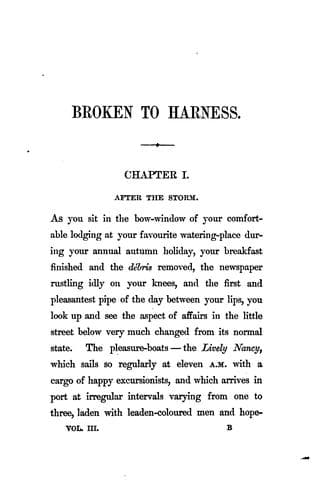
Broken to Harness: A Story of English Domestic LifeYates, Edmund
General
Broken to Harness: A Story of English Domestic Life
Yates, Edmund
England -- Fiction
For they immediately recalled to her recollection her several
interviews with her aunt, Miss Lexden, when she first announced the
engagement with Frank, and she remembered the acrimony with which the
old lady had spoken of the class to which her intended husband
belonged. The very words her aunt had used were ringing in her ears.
"If I were to see you with broken health, with broken spirits,
ill-used, deserted--as is likely enough, for I know these people,--I
would not lift one finger to help you after your degradation of me!"
"For I know these people!" Too well she knew them, it appears, when
she predicated what had actually occurred. Not deserted, though; that
at least could never be cast in her teeth. It was she who had taken
the initiative:--she who had broken the bonds and--what could the
world say to that? Would it not denounce her conduct as strange,
unwomanly, and unwifelike? And if it did, what did she care? Her
pride, her spirit, had often been spoken of; and she felt in no way
ashamed of having permitted herself to be swayed by them in this great
trial of her life. There must be many who would thoroughly understand
her conduct, and sympathise with her; and even if there were none, she
had the courage and the determination to stand alone. That she must to
a great extent have right on her side--that what she had done could
not be looked upon as extravagant or unjustifiable--was proved, she
argued to herself, by the kind reception she had met with at the hands
of Mr. Schröder, a man who, as she judged from all she had heard and
seen of him; would not be likely lightly to pass over any breach of
decorum. How or where the rest of her life was to be passed engrossed
very little of her attention at first. She knew that there was no
chance of reconciliation with her aunt; nor did she wish it. She had
quarrelled with her husband, certainly, and would never be induced to
live with him again; but her cheek flushed when she remembered what
insults had been heaped upon Frank by her aunt; and she thought almost
tenderly of him as she decided that after these insults nothing would
induce her to humiliate herself to Miss Lexden's caprices. The thought
of writing to Sir Marmaduke Wentworth crossed her mind; but Alice
Schröder had told her that Sir Marmaduke was laid up with a dangerous
illness in the Pyrenees; it would be very inopportune to worry him,
then, with domestic dissensions; and moreover Barbara was in very
great doubt as to whether the old gentleman, were he able, would not
take an active part in promoting a peace, and whether he would not
strongly disapprove of, and openly condemn, the course she had taken.
He had a very high opinion of Frank Churchill, who was his godson;
and unless it could be distinctly proved that he had committed
himself--unless it could be distinctly proved--could it? what proof
was there? had not her pride and spirit involved her in a snare? how
could she make her case good before an unbiassed judge? There was the
Public-domain text, read in full here on John Shaqi.
Reviews
Reviews
No reviews yet
Be the first to share your thoughts on this work.
Elsewhere in the archive
Join the Discussion
Join the discussion
Sign in to leave a comment or review.
Sign InorCreate an account