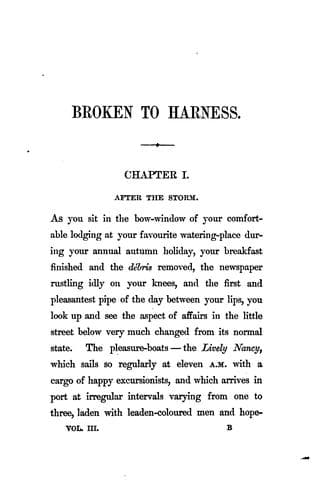
Broken to Harness: A Story of English Domestic LifeYates, Edmund
General
Broken to Harness: A Story of English Domestic Life
Yates, Edmund
England -- Fiction
If, instead of ascending the broad staircase immediately on entering
the Tin-Tax Office, you were to proceed straight forward, you would
come to the messengers' lobby, which is the outpost, protecting the
penetralia where the Commissioners and the Secretary are enshrined.
The principal duty of these messengers, besides answering bells and
carrying about official papers, was to protect the august personages
just referred to from being intruded upon by "the public;" and as one
learnt from his Scripture History that the term "Gentiles" meant "all
nations except the Jews," so, after a very little official experience,
one became aware that "the public" meant every body who did not hold
an appointment in the Tin-Tax Office. The duties incumbent upon
certain emissaries of the Office, in regard to the collection of
revenue, made the head-quarters at Rutland House a grand resort of the
"public," who generally came here with very belligerent intentions,
and who either referred to printed documents in their hands and wished
to see Mr. Simnel the Secretary (whose name appeared attached to the
documents) or occasionally even demanded an interview with the Chief
Commissioner, the great Sir Hickory Maddox, himself. It is needless to
say that these wishes were never gratified: the messengers of the
Tin-Tax Office were men to whom, in the discharge of his favourite
accomplishment, Ananias could not have held a candle; men with
imperturbable faces and ready tongues, who took the "public's" measure
in an instant, and sent him to whatsoever clerk they thought would
most readily dispose of his grievance. "I wish to see the Chief
Commissioner," would exclaim a Briton, red in face, dripping in head,
and bursting with indignation. To him calm, majestic Mr. Potts, the
chief messenger, a fat man with a big forehead, a large stomach, flat
feet in low shoes, and a general butlerish appearance--"Sir 'Ickry is
with the Chanclr of Schequer, sir, on most important bisness." "The
Secretary, then." "The Seckittary have gone with Sir 'Ickry,
sir;--what is your bisness, sir?" "Why, I've been overcharged--" "Ah,
thought so, sir! Rebate on prop'ty dooty. Walker, show the gentleman
to number 15,"--and away down the loud-resounding passages, or up the
mountainous stairs, would the unfortunate "public" be hurried.
Public-domain text, read in full here on John Shaqi.
Reviews
Reviews
No reviews yet
Be the first to share your thoughts on this work.
Elsewhere in the archive
Join the Discussion
Join the discussion
Sign in to leave a comment or review.
Sign InorCreate an account