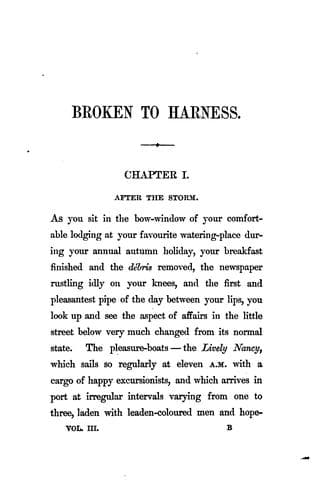
Broken to Harness: A Story of English Domestic LifeYates, Edmund
General
Broken to Harness: A Story of English Domestic Life
Yates, Edmund
England -- Fiction
Cambridge: after a lengthened interview with the head-master, the Rev.
Dr. Barker, Mr. Simnel gracefully resigned the exhibition in favour of
Swetter, _major_, who "proxime accessit," and entered as the articled
clerk of Messrs. Banner and Blair, accounted the sharpest lawyers in
Combcardingham, and known through all the county as great
electioneering agents for the Liberal party. A few years passed on;
Mr. Simnel had finished his articles had become the junior partner of
Messrs. Banner and Blair, and was working steadily and well, when an
event happened which insured his success for life.
It was this: Combcardingham, for the three last general elections, had
returned the same two members--Sir Thomas Prodd and Mr. Shuttler; both
local magnates, employing hundreds of hands, supporting local
charities, known throughout the county, and Liberal to the backbone.
One morning news sped to London that Mr. Shuttler was dead; and that
evening a tall, thin gentleman, with a hare-lip, arrived by afternoon
express in Combcardingham, and engaged the Waterloo Hotel as the
head-quarters of Mr. Farquhar, the Conservative candidate. Blue bills
on a dead-wall unpleasantly proclaimed this fact to M. Simnel as he
was shaving himself the next morning; and he perceived that young
Woofham, the hope of the Liberal party, would not be brought in
without a struggle. So he, metaphorically, took off his coat and set
to work; canvassed, intrigued, cajoled, went through all the dirty
round of electioneering tactics, but found he did not make much way;
found, in truth, that the hare-lipped man seemed to have Fortunatus's
purse somewhere about him, and that young Woofham was a miserly young
hunks, who did not see the borough as a proper investment for his
ingots. What was to be done? To lose the borough would be a tremendous
blow to the Government, who had always looked upon it as their own,
and to whom it was always supposed to owe allegiance. But the money?
The night before the nomination, Mr. Simnel, with his face muffled in
a huge handkerchief, despatched the following telegraphic message to
Mr. Weal, the Government whip, at the Retrenchment Club: "No. 104 is
putting on the steam at Combcardingham. If No. 102 does not do
likewise, up goes the sponge." While No. 102 Mall-Pall is the
Retrenchment Club, No. 104 is, it is needless to say, the No Surrender
(familiarly known as the Wig and Whiskers), the head-quarters of the
Conservative party. By the early morning express a messenger, with a
letter from Mr. Weal, arrived at Mr. Simnel's office, and during the
day the doubts under which many of the electors suffered were
satisfactorily explained away, and at the close of the poll Mr.
Woofham's name stood well ahead of his rival. Mr. Weal and his party
did not forget their telegraphing friend at Combcardingham. After the
election was over, Mr. Simnel was summoned to London, had an interview
with certain of the _Dii majors_, and at the end of six months was
Public-domain text, read in full here on John Shaqi.
Reviews
Reviews
No reviews yet
Be the first to share your thoughts on this work.
Elsewhere in the archive
Join the Discussion
Join the discussion
Sign in to leave a comment or review.
Sign InorCreate an account