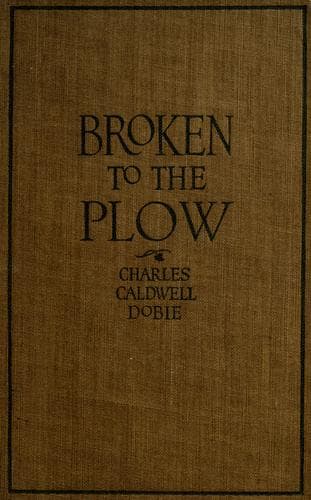
Broken to the Plow: A NovelDobie, Charles Caldwell
General
Broken to the Plow: A Novel
Dobie, Charles Caldwell
Fiction
The next morning Fred decided to chance a walk in the open. He had a
vague wish to try his wings again, now that he had grown stronger. The
situation reminded him remotely of Fairview on those first days when
Monet and he had attempted to harden their muscles against the day of
escape. But this time he was struggling to free himself from a
personality, from an idea. He must leave Storch and his motley brood
as soon as possible; somehow the acid of their ruthless philosophy was
eating away the remnants of any inner beauty which had been left him.
At first he had been all revolt, but now there were swift moments in
which he asked himself what quarrel he could have with any blows
struck at authority. What had established order done for him? Acted as
a screen for villainy and inconstancy for the most part.
He turned all this over in his mind as he slunk furtively along the
water front, trying vaguely to shape a plan of action. He felt himself
to be a very unusual and almost terrible figure, and yet no one paid
any heed to him. His beard had lost its sunburned character and grown
jet black, his face, and particularly his hands, were pale to
transparence, his eyes burned too brightly in their sunken sockets. He
was not even a ghost of his former self, but rather a sinister
reincarnation. He felt that he was even more forbidding than on that
night when he had sent Brauer shivering from his presence. He doubted
whether Brauer would recognize him again, so subtle and marked was the
change. He hardly recognized himself, and the transformation was not
solely a matter of physical degeneration. No, there was something
indefinable in the quality of his decline.
He fluttered about the town, at first aimlessly, like a defenseless
fledgling thrust before its time from the nest. He was weak and
tremulous and utterly miserable. Yet he felt compelled to go forward.
He must escape from Storch! _He must_!
The docks, usually full of bustle, were silent and almost deserted.
Fred questioned a man loafing upon a pile of lumber. It appeared that
a strike of stevedores was the cause of this outward sign of
inactivity. Boats were being loaded quietly, but the process was
furtive and sullen. Occasionally, out of the wide expanse of brooding
indolence a knot of men would gather flockwise, and melt as quickly.
There was an ominous quality in the swiftness with which these
cloudlike groups congealed and disintegrated. The sinister blight of
repression was over everything--repressed desires, repressed joys,
repressed hatreds. It was almost as sad as the noonday silence of
Fairview.
Public-domain text, read in full here on John Shaqi.
Reviews
Reviews
No reviews yet
Be the first to share your thoughts on this work.
Elsewhere in the archive
Join the Discussion
Join the discussion
Sign in to leave a comment or review.
Sign InorCreate an account