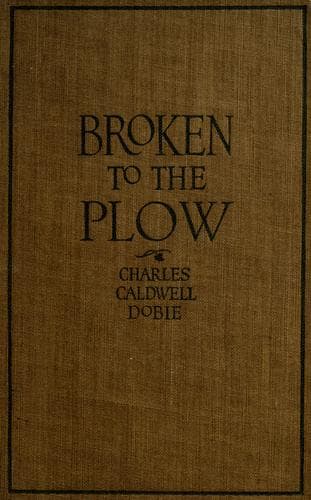
Broken to the Plow: A NovelDobie, Charles Caldwell
General
Broken to the Plow: A Novel
Dobie, Charles Caldwell
Fiction
He liked especially to talk to the cripples of industry. Here was a
man who had been blinded by a hot iron bolt flung wide of its mark,
and another with his hand gnawed clean by some gangrenous product of
flesh made raw by the vibrations of a riveting machine. And there were
the men deafened by the incessant pounding of boiler shops, and one
poor, silly, lone creature whose teeth had been slowly eaten away by
the excessive sugar floating in the air of a candy factory. Somehow
this last man was the most pathetic of all. In the final analysis, his
calling seemed so trivial, and he a sacrifice upon the altar of a
petty vanity. Once he met a man weakened into consumption by the
deadly heat of a bakeshop. These men did not whine, but they exhibited
their distortions with the malicious pride of beggars. They demanded
sympathy, and somehow their insistence had a humiliating quality. He
used to wonder, in rare moments of reflection, how long it would take
for all this foul seepage to undermine the foundations of life. Or
would it merely corrode everything it came in contact with, very much
as it had corroded him? Only occasionally did he have an impulse to
escape from the terrible estate to which his rancor had called him. At
such intervals he would turn his feet toward the old quarter of the
town and stand before the garden that had once smiled upon his
mother's wooing, seeking to warm himself once again in the sunlight of
traditions. The fence, that had screened the garden from the nipping
wind which swept in every afternoon from the bay, was rotting to a
sure decline, disclosing great gaps, and the magnolia tree struggling
bravely against odds to its appointed blossoming. But it was growing
blackened and distorted. Some day, he thought, it would wither
utterly... He always turned away from this familiar scene with the
profound melancholy springing from the realization that the past was a
pale corpse lighted by the tapers of feeble memory.
One afternoon, accomplishing again this vain pilgrimage, he found the
tree snapped to an untimely end. It had gone down ingloriously in a
twisting gale that had swept the garden the night before.
In answer to his question, the man intent on clearing away the
wreckage said:
"The wind just caught it right... It was dying, anyway."
Fred Starratt retraced his steps. It was as if the old tree had stood
as a symbol of his own life.
Public-domain text, read in full here on John Shaqi.
Reviews
Reviews
No reviews yet
Be the first to share your thoughts on this work.
Elsewhere in the archive
Join the Discussion
Join the discussion
Sign in to leave a comment or review.
Sign InorCreate an account