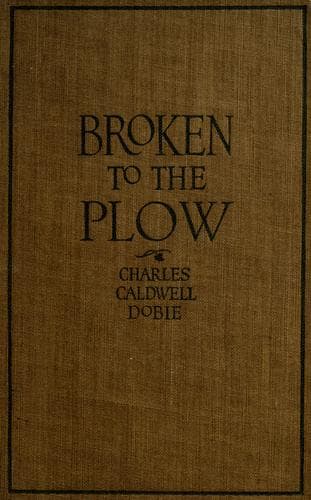
Broken to the Plow: A NovelDobie, Charles Caldwell
General
Broken to the Plow: A Novel
Dobie, Charles Caldwell
Fiction
"Does it matter in the least whether there is one victim or six?"
He repeated Storch's question over and over again. Yes, it did
matter--why, he could not have said. But even in a vague way there had
been a certain point in winging Hilmer. Hilmer had grown to be more
and more an impersonal effigy upon which one could spew forth malice
and be forever at peace. He had fancied, too, that Hilmer was his
enemy. Yet, Hilmer had done nothing more than harry him. It was Storch
who had captured him completely.
It was not that Storch was unable to discover a score of men ready and
willing to murder Hilmer, but he was finding an ironic diversion in
shoving a weary soul to the brink. He liked to confirm his faith in
the power of sorrow and misery and bitterness ... he liked to triumph
over that healing curse of indifference which time accomplished with
such subtlety. He took a delight in cutting the heart and soul out of
his victims and reducing them to puppets stuffed with sawdust,
answering the slightest pressure of his hands. How completely Fred
Starratt understood all this now! And in the blinding flash of this
realization he saw also the hidden spring that had answered Storch's
pressure. Storch may have been prodding for rancor, but he really had
touched the mainspring of all false and empty achievement--vanity.
"Losing a wife isn't of such moment ... but to be laughed at--that is
another matter!"
The words with which Storch had held him up to the scorn of the crowd
swept him now with their real significance. He had been afraid to seem
uncourageous.
Thus also had Mrs. Hilmer prodded him with her sly "What do men do in
such cases?"
Thus, also, had the terrible realization of his love for Sylvia
Molineaux been turned to false account with a wish to still the
stinging wounds of pride forever.
He had made just such empty gestures when he had battled for an
increase in salary, using Hilmer's weapons instead of his own, and
again when he had committed himself to Fairview with such a theatrical
flourish. He had performed then, he was performing now, with an eye to
his audience. And his audience had done then, and was doing now, what
it always did--treated him with the scorn men feel for any and all who
play down to them.
Already Storch was sneering with the contempt of a man too sure of his
power. He would not have risked the details of his plan otherwise. And
deep down Fred Starratt knew that the first duty to his soul was to be
rid of Storch at any cost--after that, perhaps, it would not matter
whether he had one or six or a hundred victims marked for destruction.
He was afraid of Storch and he had now to prove his courage to
himself.
Public-domain text, read in full here on John Shaqi.
Reviews
Reviews
No reviews yet
Be the first to share your thoughts on this work.
Elsewhere in the archive
Join the Discussion
Join the discussion
Sign in to leave a comment or review.
Sign InorCreate an account