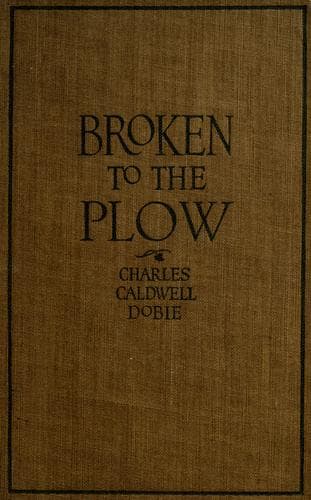
Broken to the Plow: A NovelDobie, Charles Caldwell
General
Broken to the Plow: A Novel
Dobie, Charles Caldwell
Fiction
He could see every printed phrase as plainly as if he were reading it
all himself. How many times in the old days had he not perused some
such story over his morning coffee, thanking himself unconsciously
that he was not as other men! How perfectly and smugly he had played
the Pharisee for his own delight and satisfaction! He had not bothered
then to cry his virtues aloud in the market place or to thank God
publicly for his salvation. No, he was too self-sufficient to take the
trouble to advertise his worthiness.
To-night he was on the brink of disaster, and yet he found himself
shuddering at the colorless fate to which his complacence might have
condemned him. To have gone on forever in a state of drowsy
contentment ... to have been surrounded on all sides by the thunderous
cataracts of life and caught only the pretty significance of rainbows
through the spray ... to have remained untouched by any and every
primitive impulse and feeling--he could not now imagine anything more
tragic. And yet, to-morrow, people would hold up the desirability of
his former estate, pointing to him in warning for the soft-armed
profit of an oncoming generation. He saw himself as he might have
been, going on to the end of time in the service of Ford, Wetherbee &
Co., rising from map clerk to counter man, to special agent, perhaps
even to a managership, writing sharp or conciliatory letters to agents
according to their importance, trimming office expense and shaving
salaries, heckling green office boys, and, his workday ended, going
home to _The Literary Digest_ and Helen, fresh from the triumphs of
the golf links or the card table. Yes, no doubt Helen would have
matched his own rise in fortune with equal gentility. Perhaps he might
have taken an hour between office closing and dinner to wield a golf
club himself ... bringing back a desirable guest to dinner or
proposing through the telephone to Helen that they dine at the Palace
or St. Francis... Yes, even at best his imagination could not do more
with the material in hand. Indeed, he knew that he had crowded the
very most that was possible on so small a canvas.
This, then, had been his unconscious life plan, his unvoiced fate.
Thus had he sketched it hazily, as a teller of tales sketches the plot
of a story, such and such a sum being the total of all the characters
and circumstances. But as he had gone on developing it, suddenly a new
character had appeared to change the final figures--a wrench thrown
into the wheel of continuity ... a wrench that bore the name of Axel
Hilmer... He felt no bitterness now for the man. Had he ever felt it?
Public-domain text, read in full here on John Shaqi.
Reviews
Reviews
No reviews yet
Be the first to share your thoughts on this work.
Elsewhere in the archive
Join the Discussion
Join the discussion
Sign in to leave a comment or review.
Sign InorCreate an account