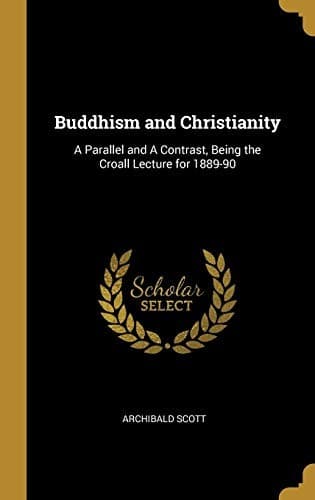
Buddhism and Christianity: A Parallel and a ContrastScott, Archibald
Religion
Buddhism and Christianity: A Parallel and a Contrast
Scott, Archibald
Buddhism -- Relations -- Christianity; Christianity and other religions -- Buddhism
concerning Him was, “Is not this Messias?” Among the earliest
declarations made was, “We have found the Messias.” Very soon in His
career He confessed, “I that speak unto thee am He!” The Gospels and
Epistles would be unintelligible without this perpetual reference to
Messianic prediction; it is the golden thread which runs through all the
Old Testament and unites it with the New. In its Messianic hope, Old
Testament prophecy reached its highest and purest development, and the
New Testament claims that in Christ it is finding its fulfilment. It may
be alleged of course that the prophecy and the claim are alike
delusions, but the prophecy at least was a fact, and its application to
Christ was no legendary growth of a later generation, but the original
and essential testimony of the earliest Christian teachers.
The other conception of Perfect Wisdom represented by Buddha the
Awakened or Enlightened One is also confessedly an aftergrowth. The
earliest traces which we have of Gotama after his death disclose him as
a man who gained his knowledge by severe struggle, and who therefore, in
the estimation of his followers, was a “Jina” or conqueror. As time went
on, and his memory rose in the estimation of later generations, the
faithful, guided by their belief in transmigration, projected this
struggle for Buddhahood further and further into former stages of
existence, till at last the idea was conceived that he was only one of a
long series of Buddhas, of whom he was not to be the last. The
development of this interesting speculation, with its distinctions into
Buddhas who only save themselves—Paccekabuddhas—and the Sammâsambuddhas,
who appear at very rare intervals, able and willing to save to the
uttermost, need not here be traced. It is sufficient to note how unlike
and contradictory is this belief to that which dominates in our
religion. In Christ we have the _only_ Messiah, and He, having once
come, we do not look for another. The hope of the Christian is fixed
upon His coming again in glory; but it is the coming again of the _same_
Jesus. The unity of Deity colours and pervades all our thoughts of
Divine communications with mankind; “there is one God, and one Mediator
between God and man.” Consequently the doctrine of the Divine Word
formulated in connection with Christ in St. John’s Gospel represents a
very different set of ideas from the conception of Buddha as the Perfect
Wisdom, to whom all worlds and all times were open. That conception of
Buddha was probably an incorporation into the Buddhist creed from
foreign sources, but the idea of Christ as the Son, “unto whom all
things have been delivered by the Father,” so that “no one knoweth the
Son save the Father, neither doth any know the Father save the Son, and
he to whomsoever the Son willeth to reveal Him,” was a common one among
the very earliest Christians of whom we have any trace. St. Matthew, St.
Mark, St. Paul, St. Luke all preach Christ, “unto whom has been
Public-domain text, read in full here on John Shaqi.
Reviews
Reviews
No reviews yet
Be the first to share your thoughts on this work.
Elsewhere in the archive
Join the Discussion
Join the discussion
Sign in to leave a comment or review.
Sign InorCreate an account