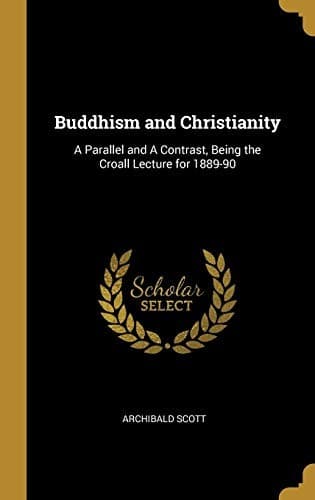
Buddhism and Christianity: A Parallel and a ContrastScott, Archibald
Religion
Buddhism and Christianity: A Parallel and a Contrast
Scott, Archibald
Buddhism -- Relations -- Christianity; Christianity and other religions -- Buddhism
Let any one compare the prediction of the so-called Indian Simeon, the
Nalaka Sutta, in vol. x. p. 125 of _Sacred Books of the East_, with
Luke ii. 25; the account of the Temptation by Mara, in the _Romantic
Legend_, pp. 204, 224, or in Hardy’s _Manual of Buddhism_, p. 183,
with Matt. iv. 1; the so-called Transfiguration in Mahâparinibhâna,
iv. 49, vol. xi. _Sacred Books of the East_, p. 81, with Matt. xvii.
1-8; the feast of the courtesan Ambopali, in Mahâparinibhâna Sutta,
ii. 16. 25, _Sacred Books of the East_, vol. xi. p. 30, with Christ’s
treatment of the Magdalene in Luke vii. 36, and he will see at once
how improbable and even absurd is the theory that the Evangelists
borrowed from the Buddhist compilers. That we are dealing with quite
an inferior order of facts is apparent when we compare one of the most
touching coincidences, Buddha’s last discourse to the Beloved Ananda
in Mahâparinibhâna Sutta, v. 34. 35, “Let not yourself be troubled,”
with John xiv. 1-6. In some of the miracles accompanying the birth and
temptations of Buddha, there are not only gross absurdities but
positive indecencies, which by the simplicity and modesty and
reticence of the Gospel narratives are powerfully condemned. See
_Lalita Vistara_, chaps. vi. and vii., and _Buddhist Birth-Stories_,
vol. i. pp. 58, 68.
Footnote 159:
This is a very great assumption indeed. Foucaux, its translator,
assigns it to the first century B.C., but T. W. Rhys Davids assigns it
to some Nepaulese poet “who lived between six hundred and a thousand
years after Buddha’s death” (Hibbert Lectures, pp. 197, 204). A
Chinese version is said to have been in existence about 70 A.D.
Rajendralal Mitra, its English translator, admits this in his
Introduction, p. 48, but whether that was a version, or another book
altogether, or how far it corresponded with the _Lalita Vistara_, no
scholar has been confident to say. Dr. Beal also mentions a life of
Buddha by Asvaghosha as probably in circulation about the middle of
the Christian era (_Chinese Buddhism_, p. 73).
Footnote 160:
Mahâparinibhâna Sutta, translated by T. W. Rhys Davids, _Sacred Books
of the East_, vol. xi.
Footnote 161:
Public-domain text, read in full here on John Shaqi.
Reviews
Reviews
No reviews yet
Be the first to share your thoughts on this work.
Elsewhere in the archive
Join the Discussion
Join the discussion
Sign in to leave a comment or review.
Sign InorCreate an account