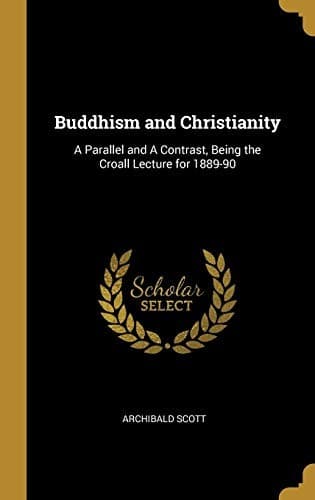
Buddhism and Christianity: A Parallel and a ContrastScott, Archibald
Religion
Buddhism and Christianity: A Parallel and a Contrast
Scott, Archibald
Buddhism -- Relations -- Christianity; Christianity and other religions -- Buddhism
And what was Nirvana, the final refuge of the emancipated Buddhist? Ever
since the religion was known in Europe great diversity of opinion has
prevailed as to the meaning of this word. It was employed by the
Brahmans many centuries before Buddha’s day, and used by them and by
himself and his disciples in so great a variety of senses that even the
learned Rajendralala Mitra, in enumerating the sects into which orthodox
Buddhists are divided in regard to it, confessed some years ago that he
had given up in despair the attempt to ascertain its meaning.[203] The
researches and discoveries of later years have enabled the translators
of the texts to write with less hesitation as to its significance, and
we are entitled to accept as solid the results of their patient
investigations. To begin with, they tell us that it means the peace
which ensues when all passion has been subdued, and all selfish craving
has been extinguished. Though practically no Buddhist hopes to attain to
it here, but only to enter the paths leading to it, it may be reached,
not in anticipation only, but in fruition.[204] Buddha may be said to
have been in Nirvana forty years, for he entered it, not in the moment
of dying, but when he attained perfection. This first conception of it,
therefore, seems a marvellous anticipation of the faith of the
Christian, who finds his heaven and enters into his rest when he is
delivered from the φρόνημα τῆς σάρκος, from all selfish clutching at the
means of existence. In both religions, taken at their highest, the goal
of aspiration was not extinction of sorrow, but extinction of self-love:
in Buddhism the quenching of _trishna_, or _upádána_, “thirst,” in
Christianity the quenching of ἐπιθυμία, “lust,” “inordinate desire.” In
both religions the goal meant finality, a state in which there was an
end of death; and in both, moreover, it meant a change which no language
could define, and to which no known standard could apply. The Christian
believer tells us that he is passing from the visible to the invisible,
from the temporal to the eternal, and in like manner the Buddhist Arahat
would only be able to allude to the great change by negations, and as
the very opposite of all we know or at present conceive. The Christian
believes in the perseverance of the saints, and the Buddhist who has
really entered the path must sooner or later reach his prize.
Public-domain text, read in full here on John Shaqi.
Reviews
Reviews
No reviews yet
Be the first to share your thoughts on this work.
Elsewhere in the archive
Join the Discussion
Join the discussion
Sign in to leave a comment or review.
Sign InorCreate an account