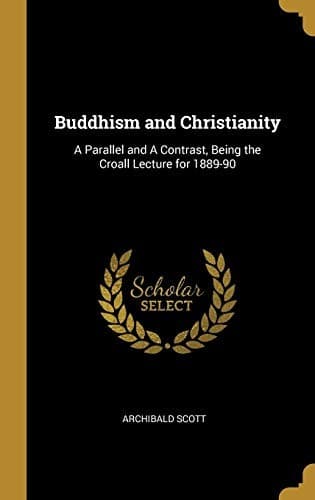
Buddhism and Christianity: A Parallel and a ContrastScott, Archibald
Religion
Buddhism and Christianity: A Parallel and a Contrast
Scott, Archibald
Buddhism -- Relations -- Christianity; Christianity and other religions -- Buddhism
Ignoring God, it could only form, or could not emancipate itself from, a
false conception of man, as part of a material system of things; but
man, though considerably involved in a material system, never can be
interpreted by it. On the contrary, nature can only be interpreted or
properly understood in man as the lower in the higher. Man is an
antagonist of nature; he is for ever condemning its ways, coming into
collision with its laws, refusing to live its life. Out of this
collision emerges his religion, while his morality originates in the
conflict between his own sense of duty and its life of animal
instinct.[241] To conform to nature, he must become a brute, but he has
in him ideals and capacities transcending it, and by exercising these
capacities in pursuit of his ideals he finds his life. Buddha confessed
to an ideal, and wrought hard to realise it, but alas for humanity when
it finds no higher than self to reverence! Buddha’s theories of
self-culture and self-deliverance reduced to practice have proved most
miserable failures. It could not be otherwise; no man is likely to move
the ship in which he sits by puffing away at the sails, or to lift
himself out of the mire by simply pulling away at his boots; and no
philosophy of self-culture, self-control, or self-rescue, can succeed,
which ignores or refuses to acknowledge man’s instinct of worship. What
he most needs is not law, not a system of morality, not even an example
or model to copy, but inspiration. He knows already enough to condemn
himself, and he has examples which, though far from perfect, quite
suffice to confound him. The command to be perfect mocks him as truly as
a command to see would mock a man stone-blind. What he does want is a
powerful moral energy within him, for lack of which he has to confess
that he cannot do the good he would, but is ever doing the evil which he
would not. His real wretchedness is not his suffering and death, not
even his ignorance, as Buddha thought, but the continual and seemingly
ineffectual struggle between the animal and the man, the flesh and the
spirit. And Buddhism was powerless to help him here. It lacked the
steady support of the sense of duty to the highest and best, the
inspiration that comes from the faith that the highest and best is for
us, and is with us, and in us. Belief in God, as Bacon reminds us, is
“essential to the consciousness of our nobility and dignity, for
certainly man is of kin to the beasts by his body, and if he be not of
kin to God by his spirit, he is a base and ignoble creature.” So
Buddhism in unduly exalting man to the level of deity has in reality
degraded him. It has indeed lifted wild races out of barbarism, but it
has failed to civilise them. It has certainly not destroyed ignorance,
and the worship of intelligence has not tended to its development and
diffusion among the peoples whom it has swayed. Judged even by an
ordinary standard, the monks of either Southern or Northern Buddhism are
Public-domain text, read in full here on John Shaqi.
Reviews
Reviews
No reviews yet
Be the first to share your thoughts on this work.
Elsewhere in the archive
Join the Discussion
Join the discussion
Sign in to leave a comment or review.
Sign InorCreate an account