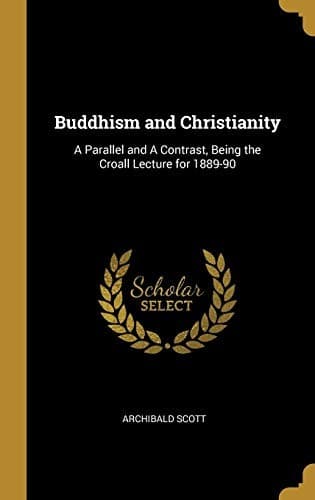
Buddhism and Christianity: A Parallel and a ContrastScott, Archibald
Religion
Buddhism and Christianity: A Parallel and a Contrast
Scott, Archibald
Buddhism -- Relations -- Christianity; Christianity and other religions -- Buddhism
attempt to secure our own happiness here or in a better world hereafter;
but He offers the heaven and Nirvana which He found in assuming the
burdens of others, and in bearing their cross. So He assures us that it
is worth our while to live, even in a world groaning and travailing with
suffering, and that it will be worth our while, even in agony if we
must, to die. It is indeed a very evil world, but as long as we draw our
inspiration from Him we can live in it not only without damage but with
great profit. When we offer ourselves in His strength for its salvation
we will be saved from its sins. In the times of our deepest distress we
will have the peace which He left us, and when most severely beset and
cast down with sorrow because of what seems baffled endeavours, we have
only to think of that hope of ultimate victory which made Him to endure
to the end, to rise into
“that last large joy of all,
Trust in the goodness and the love of Him
Who, making so much well, will end all well.”
Footnote 180:
_Dharma_, an ancient Brahman term, meaning law or order; what holds
things as they are, or ought to be. In later Sanskrit it also means
duty and virtue, _i.e._ law performed.—Gifford Lectures, _Natural
Religion_, pp. 94, 95. _Buddha_ is also an ancient Brahman term
applied to one who has attained a perfect knowledge of the
Self.—Satapatha-brahmana, xiv. 7. 2. 17. In Buddhism Dharma means
Buddha’s doctrines, “bodhi,” _i.e._ knowledge self-acquired, as
distinguished from “Veda,” _i.e._ revelation obtainable only through
the Brahmans.—Sir Monier Williams’ _Buddhism_, p. 97.
Footnote 181:
Oldenberg, _Buddha, etc._, pp. 205-208; Rhys Davids, _Buddhism_, p.
87; Spence Hardy, _Manual of Buddhism_, p. 375. His relation to the
philosophical systems of his day is illustrated in several Suttas; see
Sutta Nipâta, in vol. x. Part ii. of _Sacred Books of the East_, pp.
148-152. Evidently he regarded them with aversion, and even contempt.
Footnote 182:
_Le Bouddha, etc._, p. 79. The legends indicate that his use of the
vernacular was matter of principle. Two Brahmans, “excelling in
speech, excelling in pronunciation,” complained that the monks
corrupted the word of the Buddhas by repeating it in their own
dialect, and asked permission to put it into classical or polished
verse. “How can you, O foolish ones, speak thus?... You are not, O
monks, to put the words of the Buddhas into polished (Sanskrit) verse.
Whosoever does so shall be guilty of a dukkata.”—Kullavagga, v. 33. 1;
_Sacred Books of the East_, vol. xx.
Footnote 183:
Mahâparanibhâna Sutta, ii. 1. 2; _Sacred Books of the East_, vol. xi.;
Mahavagga, i. 6. 18, 27; _ibid._ vol. xiii.
Footnote 184:
Not as the Nothing, as Wuttke tries to show in _Geschichte des
Heidenthums_, ii. § 166. Oldenberg, _Buddha, etc._, p. 212.
Footnote 185:
Public-domain text, read in full here on John Shaqi.
Reviews
Reviews
No reviews yet
Be the first to share your thoughts on this work.
Elsewhere in the archive
Join the Discussion
Join the discussion
Sign in to leave a comment or review.
Sign InorCreate an account